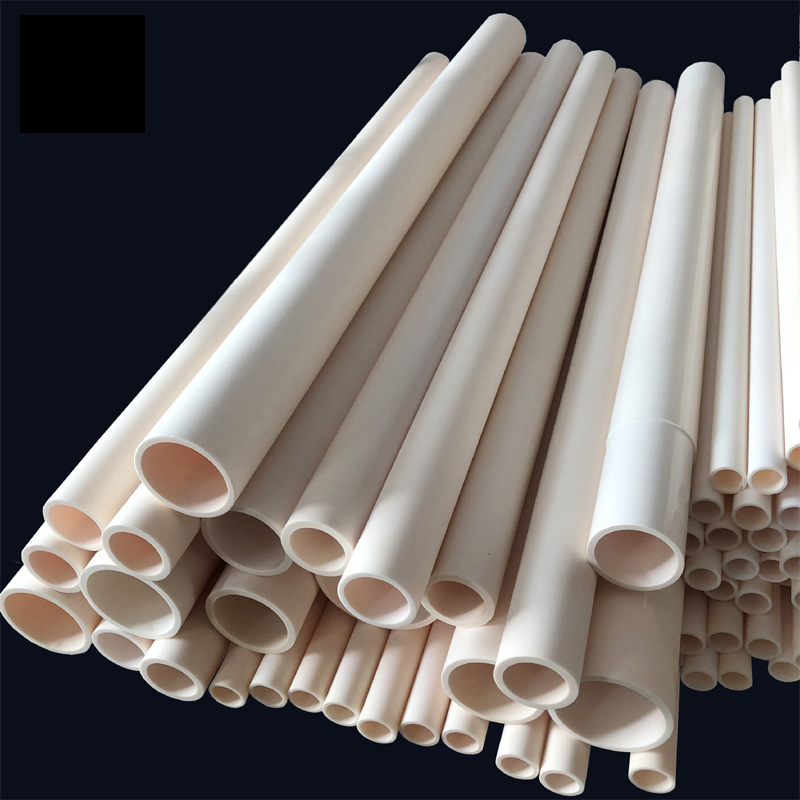
In high-end fields such as industrial manufacturing, semiconductors, and scientific research experiments, high-purity alumina tubes have become indispensable core components due to their excellent high-temperature resistance, corrosion resistance and superior electrical insulation properties. However, their price is often several times or even dozens of times higher than that of ordinary alumina tubes, leaving many enterprises and purchasers confused about the price gap. After interviewing multiple alumina material manufacturers and industry experts, we have learned that high raw material entry thresholds, sophisticated production processes, stringent quality control, and high-end application value jointly drive up the price of high-purity alumina tubes. Behind its premium price lie irreplaceable technical barriers and outstanding quality advantages.
Raw material purity is the core determinant of price, and it also marks the essential difference between high-purity alumina tubes and ordinary products.
Ordinary alumina tubes mostly adopt alumina powder with a purity of around 95%, which can meet the demands of general wear-resistant and corrosion-resistant application scenarios. In contrast, high-purity alumina tubes require alumina powder purity of over 99%. For products applied in fields such as semiconductors and precision instruments, the purity standard is even as high as 99.7% or 99.9%.
Complex and stringent production processes are the key factor driving up prices. Unlike ordinary alumina tubes which adopt extrusion molding technology, high-purity alumina tubes require more precise molding methods such as slip casting or isostatic pressing according to specific application scenarios, among which isostatic pressing is the core choice for high-end products.
In contrast, the extrusion molding process used for conventional alumina tubes is suitable for mass production, featuring simple procedures and low costs. The technical differences between the two are directly reflected in their final prices.
Strict quality control and testing standards further increase the overall cost of high-purity alumina tubes. The production yield of high-purity alumina tubes is relatively low. Any defects such as dimensional deviation, cracking, or excessive impurities will result in direct scrapping, which also indirectly drives up the production cost per unit product.
The irreplaceability in high-end application fields determines the market acceptance of its price. With excellent high-temperature stability, superior electrical insulation and chemical corrosion resistance, high-purity alumina tubes play an irreplaceable role in industries such as semiconductors, new energy, medical equipment and scientific research experiments.