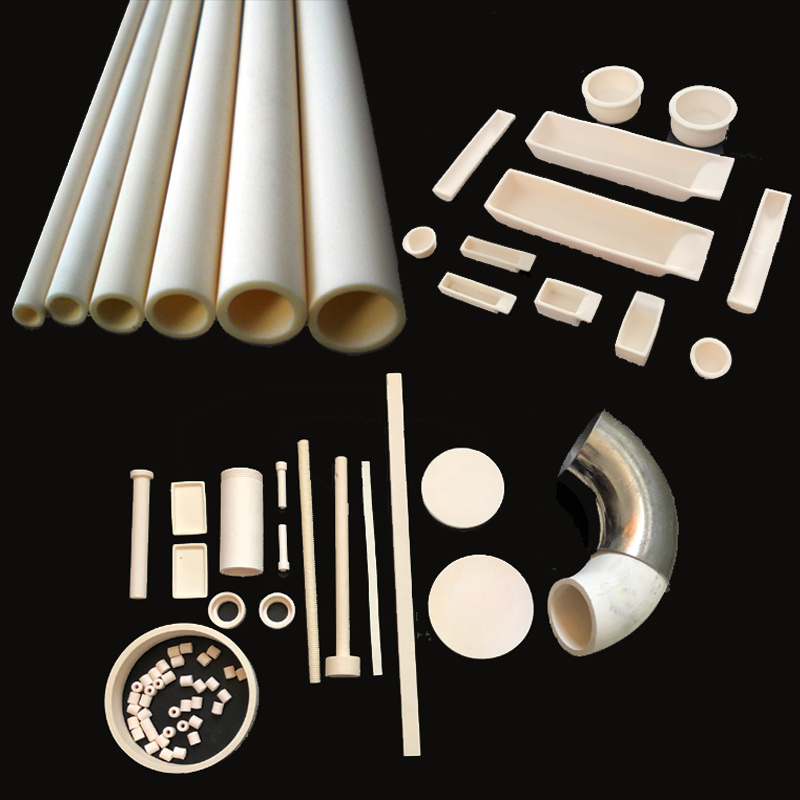
In terms of application scenarios, 99.3% alumina ceramic tubes are highly adaptable and widely used in multiple booming industrial sectors.
In the metallurgy industry, they serve as diversion pipes and feeding pipes for high-temperature molten liquids such as aluminum and copper liquid, solving the pain points of traditional pipes being prone to softening and wear.
In the chemical industry, they are applicable to conveying pipelines for acid-base media and chemical slurry, as well as spray pipes for desulfurization and denitrification equipment, greatly improving the operational stability of facilities.
In the electronics and semiconductor industry, they can be used as insulating sleeves for vacuum sintering furnaces and high-temperature process pipes for wafer manufacturing, helping raise the yield rate of chip production.
In the new energy industry, they are suitable for processes such as sintering of lithium battery cathode materials and purification of photovoltaic silicon materials, meeting the requirements for high-purity material conveying and high-temperature corrosion protection.
In addition, customized specifications are available according to the demands of different industries, including both-end open, one-end open and half-pipe types, which can flexibly adapt to the installation requirements of various industrial equipment.
Industry experts state that China's domestic industrial sector is currently undergoing a transformation toward high-end, refined and green development, with continuously rising performance requirements for core components.
The mass production of 99.3% alumina ceramic tubes has not only broken through the technical bottlenecks in purity control and process stability for medium-to-high-end industrial ceramic tubes, but also ended the reliance on imports for high-end products, driving the upgrading of China’s alumina ceramic material industry toward high-value-added sectors.
Statistics show that from 2021 to 2025, the compound annual growth rate of China’s ceramic tube market size reached 8.1%. Among this, the market share of high-purity special ceramic tubes has increased significantly. The launch of the 99.3% alumina ceramic tubes will further enrich the supply of high-end products and align with the development trend of the industry.
It is reported that the manufacturer of this product has established a complete system covering R&D, production and testing. By optimizing production processes, it has achieved stable mass supply of the product. Meanwhile, relying on its customized service capabilities, it can accurately meet the personalized needs of customers in different industries.