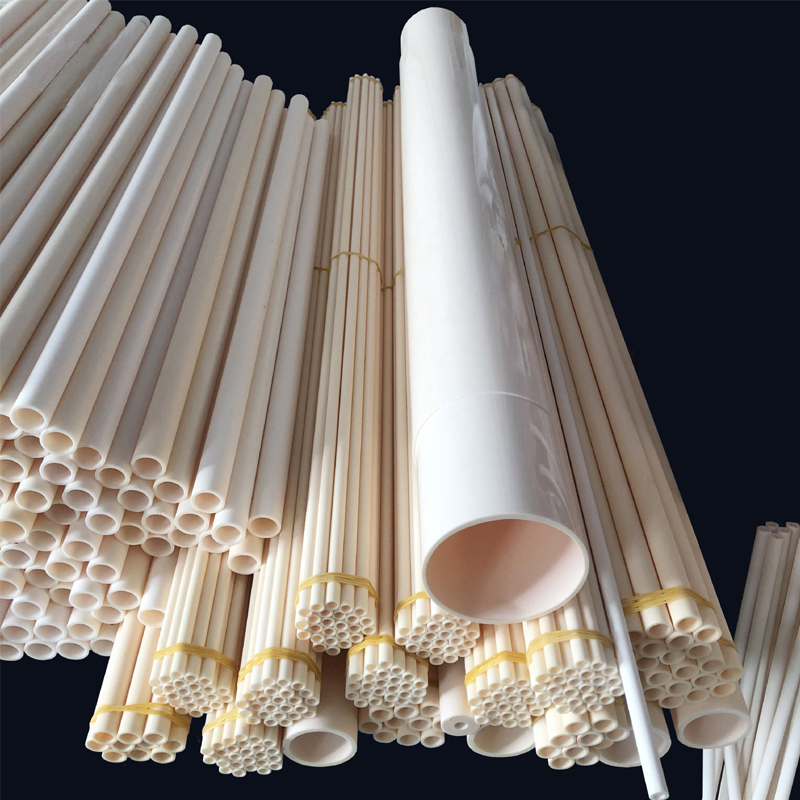
99.3% alumina ceramic tubes are widely used in core industries such as electronics, metallurgy, chemical engineering and new energy due to their balanced mechanical properties and excellent chemical stability. As a core index to measure assembly precision and service performance, dimensional tolerance directly determines the fitting degree, operational stability and service life between ceramic tubes and equipment.
The dimensional tolerances of alumina ceramic tubes are divided into two categories: international standard tolerances and customized tolerances. Among them, international standard tolerances are formulated based on globally accepted precision standards for ceramic products and combined with the forming and processing characteristics of this material. They serve as the default basic precision specifications in the industry and are applicable to most conventional industrial scenarios.
The international standard tolerances for 99% alumina ceramic tubes comply with international norms such as ISO 6474-1, mainly covering six core indicators: outer diameter, inner diameter, length, wall thickness, straightness and concentricity, with clear and universally applicable tolerance ranges for all dimensions.
Among them, outer diameter tolerances vary by tube size. For standard alumina ceramic tubes with diameters ranging from Φ5mm to Φ50mm, the standard international tolerance is ±0.02mm to ±0.50mm, while large-diameter tubes above Φ50mm allow a wider tolerance of ±0.50mm to ±1.0mm. The inner diameter tolerance is slightly looser than that of the outer diameter, ranging from ±0.05mm to ±1.0mm for common specifications, which is mainly affected by the aperture control accuracy during the forming process.
In terms of length tolerance, the international general standard classifies alumina ceramic tubes into three grades by length: short tubes (length ≤ 100 mm) with a tolerance of ±0.10 mm, medium-length tubes (100 mm < length ≤ 500 mm) with a tolerance of ±0.20 mm, and long tubes (length > 500 mm) with a tolerance ranging from ±0.30 mm to ±0.50 mm, which balances machining accuracy and production efficiency.
Wall thickness tolerance is positively correlated with wall thickness dimension. Conventional wall thickness (0.5 mm-5 mm) has a tolerance of ±0.05 mm to ±0.15 mm, while that of thick-walled tubes (wall thickness > 5 mm) can be relaxed to ±0.20 mm.
In addition, the straightness shall be controlled within ≤0.15 mm TIR and concentricity within ≤0.05 mm TIR, ensuring no deflection, vibration and other issues occur during high-speed operation or precision assembly of ceramic tubes.
It is worth noting that the precision of alumina ceramic tube customized tolerances is directly related to costs and production cycles. The higher the precision requirement, the more complex the processing technology required, the longer the production cycle, and the correspondingly higher the cost. Industry insiders suggest that when enterprises select 99.3% alumina ceramic tubes, they should combine their own application scenarios and give priority to products with international standard tolerances to control costs. For high-end precision assembly and special working conditions, enterprises can cooperate with professional ceramic manufacturers to customize tolerance specifications that meet actual demands, so as to strike a balance between performance and cost.