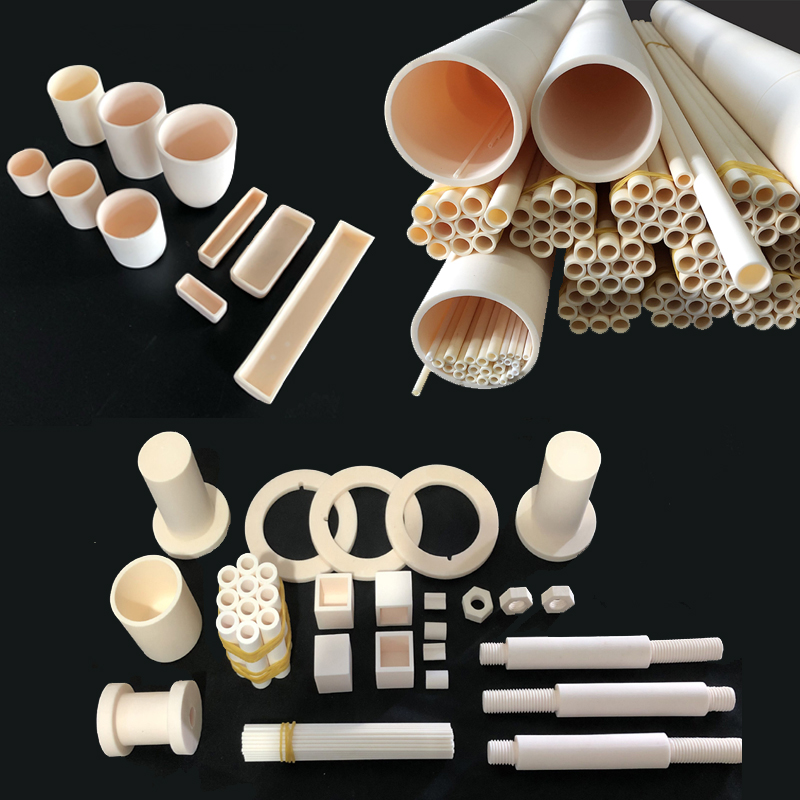
Outstanding hardness and excellent wear resistance are among the most competitive properties of alumina ceramics. According to tests by the Shanghai Institute of Ceramics, Chinese Academy of Sciences, its Rockwell hardness can reach HRA 80–90, and its Mohs hardness is as high as grade 9, second only to diamond and silicon carbide, far superior to ordinary wear-resistant steel and stainless steel.
With excellent high-temperature resistance and thermal stability, alumina ceramics serve as a "reliable performer" under high-temperature conditions. It is reported that the melting point of alumina ceramics is as high as 2050 °C. The maximum operating temperature for products of different purities ranges from 1250 °C to 1800 °C. Among them, high-purity alumina ceramics can operate stably for a long time in high-temperature environments of 1620 °C to 1800 °C. Meanwhile, they feature a low coefficient of thermal expansion, which is only (6.5–9.1)×10⁻⁶/°C in the range of 25 °C to 1000 °C. With outstanding thermal stability, their thermal shock resistance is superior to that of ordinary ceramics.
It boasts strong chemical stability and excellent corrosion resistance, enabling it to easily cope with complex and harsh working environments. Alumina ceramic exhibits good chemical inertness. With the exception of hydrofluoric acid and hot concentrated alkalis, it can effectively resist the erosion of various acids, alkalis and molten metals, and its performance degrades slowly in corrosive media.
Its excellent electrical insulation properties provide important support for the development of the electronic information industry.Alumina ceramics have a room-temperature resistivity exceeding 10¹⁴ Ω·cm, a dielectric strength ranging from 8.3 to 10.0 kV·mm⁻¹,along with a low dielectric constant and low loss in high-frequency signal transmission.At a frequency of 1 MHz and 25 °C, its dielectric constant is only 8.2 to 9.9.
In addition to the core properties mentioned above, alumina ceramics offer many additional advantages. With a density of only 3.30–4.10 g·cm⁻³, roughly half that of steel, they can significantly reduce equipment load. High-purity alumina ceramics exhibit good biocompatibility, making them suitable for medical applications such as artificial joints and dental implants. Furthermore, bauxite—the raw material for alumina ceramics—is widely abundant, with mature manufacturing processes. Medium- and low-purity grades feature controllable costs, are free of heavy-metal pollution, and comply with environmental protection standards.
Industry experts note that the excellent properties of alumina ceramics make them an ideal alternative to traditional materials such as metals and plastics. At present, toughening treatments via the addition of zirconia and other substances have effectively mitigated their high brittleness, further expanding their application scope.
Driven by innovations including 3D printing and low-temperature sintering, alumina ceramics are gradually evolving toward higher precision, composite functionality, and intelligence. Their application potential in emerging fields such as new energy, semiconductors, and deep-space exploration will continue to be unlocked, injecting new momentum into the high-quality development of high-end manufacturing.