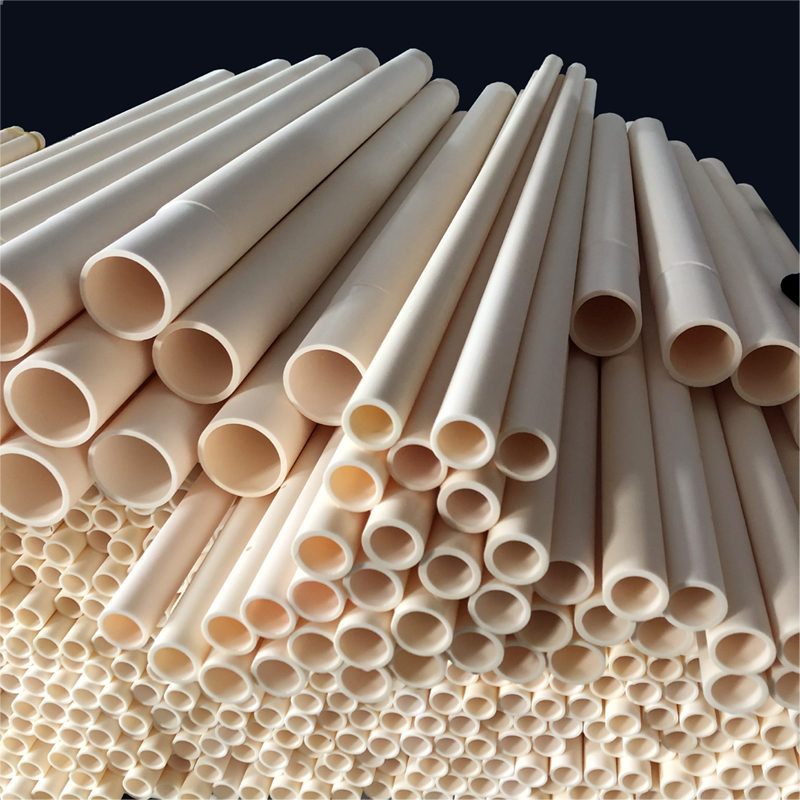
In the high-end aerospace field where reliability and performance are pursued to the utmost, the material selection of every core component holds the key to the success or failure of missions. Alumina ceramic tubes break through the limitations of traditional metal materials with multiple core advantages including high temperature resistance, light weight, corrosion resistance and strong insulation. They are widely applied in various equipment such as rockets, satellites and aircraft, emerging as the "unsung heroes" that underpin the technological upgrading of the aerospace industry.
In rocket propulsion systems, alumina ceramic tubes perform critical functions of high-temperature protection and medium conveyance. During a rocket launch, the temperature in the combustion chamber can exceed 2000℃, yet alumina ceramic tubes can operate stably at 1600℃ for long periods and withstand temperatures in excess of 1800℃ for short durations. They are widely used as high-temperature fuel diversion sleeves and nozzle insulation components: in direct contact with high-temperature gas, they effectively prevent leakage and deformation, safeguarding the stable operation of the propulsion system. Meanwhile, they simplify the design of cooling structures and contribute to weight reduction and efficiency improvement.
In the field of satellites and spacecraft, alumina ceramic tubes precisely meet the core requirements of lightweight design, high precision and resistance to extreme environments. With a density only one-third that of stainless steel, they significantly reduce the weight of components while ensuring high strength. Applied to structures such as satellite gyroscope brackets and solar array terminals, they can both withstand orbital transfer impacts and lower launch costs. Faced with intense space radiation, extreme temperature differences and corrosive propellants, their chemical stability and radiation resistance ensure long-term maintenance-free operation of pipelines. They play a pivotal role in components including propellant storage tank pipelines and optical lens brackets, safeguarding the precision and service life of equipment.
In aero-engines and airborne equipment, alumina ceramic tubes stand out for their superior insulation and wear resistance. Serving as insulating sleeves for the feed lines of aircraft radar antennas, they can isolate electromagnetic interference, withstand high operating temperatures, and improve signal transmission efficiency. For components such as hydraulic pipelines and fuel nozzle sleeves, their excellent dimensional stability and fatigue resistance can overcome the drawbacks of metal pipelines that are prone to deformation and corrosion, extend service life, reduce the weight of the fuselage, and lower fuel consumption simultaneously.
It is reported that with the technological advancement in fields such as deep space exploration and hypersonic vehicles, researchers are upgrading the performance of alumina ceramic tubes through processes like material doping and precision forming, further enhancing their high temperature resistance and impact resistance, and expanding their application scenarios. In the future, this "small component" will continue to empower the aerospace industry and provide more reliable material support for humanity's exploration of the universe.