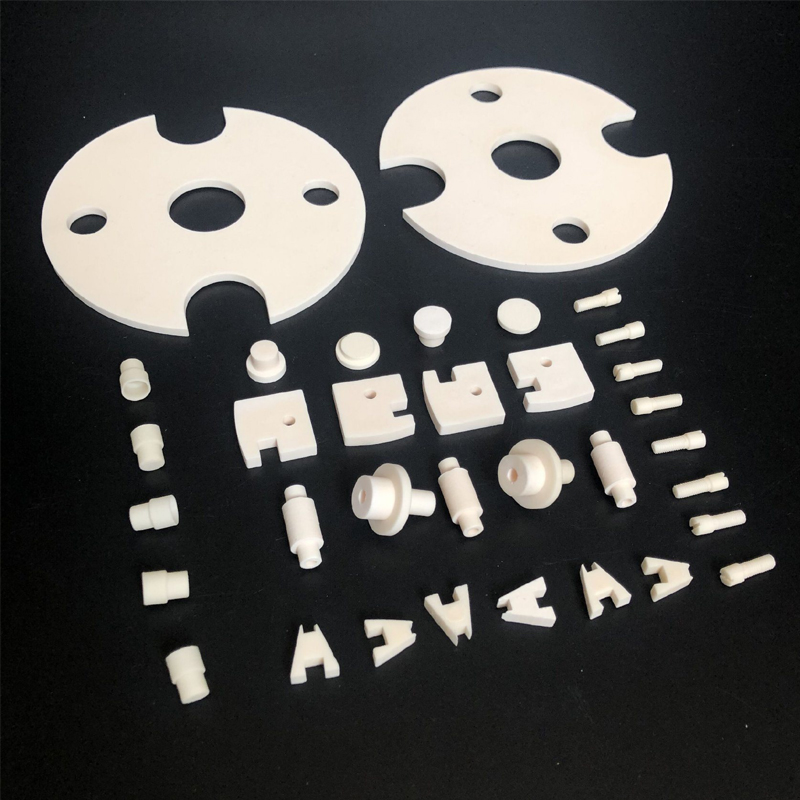
As the "king of cost performance" in the field of special ceramics, alumina ceramic parts, with their outstanding properties such as high temperature resistance, excellent insulation, and corrosion and wear resistance, have quietly penetrated into many core sectors of the national economy including new energy, electronics, chemical engineering, and medical treatment. They have become key basic components that drive the upgrading of high-end manufacturing and help enterprises reduce costs and improve efficiency.
Alumina ceramic is an inorganic non-metallic material made primarily from alumina through forming and high-temperature sintering.According to the alumina content, it can be divided into several categories, including high-purity alumina ceramic (Al₂O₃ content ≥ 99.9%), 99 alumina ceramic, 95 alumina ceramic, 85 alumina ceramic, etc.Among them, 95 alumina ceramic has become the most widely used type in the industrial field due to its balanced performance and outstanding cost performance.Compared with traditional materials such as metals and plastics, the core advantages of alumina ceramic are particularly significant.
In the rapidly evolving field of new energy vehicles (NEVs) today, alumina ceramic parts have emerged as the "invisible backbone" of the upgrade to 800V high-voltage platforms, precisely addressing the core pain points of the industry.
Reporters learned from the supply chains of multiple automakers that 95 alumina ceramics are now widely used in core components such as high-voltage DC relay housings, insulating sleeves for power battery connectors, and motor bearing balls. Their ultra-high insulation effectively mitigates the risk of high-voltage breakdown, reducing the failure rate of electronic control systems in 800V models by 60%.
The exceptional heat resistance slows the propagation of thermal runaway in power batteries, gaining over 10 minutes of precious time for passenger evacuation. Furthermore, their high hardness extends the service life of motor bearings to 500,000 kilometers, three times that of steel bearings.
Tests conducted by leading automakers such as BYD demonstrate that battery modules adopting alumina ceramic sealing rings exhibit no leakage even after 50,000 kilometers of continuous vibration, while doubling the battery lifespan. This makes alumina ceramics a pivotal choice for automakers aiming to cut costs and enhance efficiency.
In the field of electronic information and semiconductors, alumina ceramic parts serve as the core support ensuring the precise operation of equipment.With extremely high purity and insulation properties, high-purity alumina ceramics are used in high-end integrated circuit substrates, semiconductor vacuum chambers, high-pressure sodium lamp arc tubes, and other components.Among them, ceramic substrates with a purity of over 99% deliver efficient heat dissipation while ensuring high-frequency signal integrity, meeting the packaging requirements of high-power laser diodes and SiC power devices, and supporting the domestic upgrade of semiconductor equipment.Data shows that the domestic production rate of precision ceramic parts for semiconductors rose from less than 10% to 15% in 2023 and is expected to exceed 30% by 2026.
In the consumer electronics sector, the wear and scratch resistance of alumina ceramics has made them the material of choice for mobile phone camera lenses and smart watch bezels, balancing practicality and aesthetics.
In addition to high-end manufacturing, alumina ceramic parts are also widely and practically applied in traditional industries, healthcare, environmental protection and other fields.
In the chemical industry, 85-alumina and 95-alumina ceramics are used to produce chemical valve linings, wear-resistant liners for reaction kettles, sandblasting nozzles, etc., thanks to their excellent corrosion resistance and metallized sealing performance. After replacing traditional metal parts, equipment maintenance costs are reduced by more than 40% and production efficiency is increased by 25%.
In high-wear scenarios such as mining and thermal power plants, the service life of alumina ceramic liners is 5–10 times that of metal materials, greatly reducing downtime for replacement.
In the medical field, alumina ceramics are used to manufacture implants such as artificial joints and orthopedic bone screws due to their outstanding biocompatibility. Their wear resistance far exceeds that of metal implants, which can reduce the joint revision rate of patients by 80%, helping patients recover their health.
In the environmental protection sector, their corrosion resistance and high-temperature resistance make them suitable for components in sewage treatment equipment, waste incinerators and other facilities, effectively extending equipment service life and lowering environmental treatment costs.
Industry data shows that the market size of China's alumina ceramic products is expected to reach 48.5 billion yuan in 2026, with an average annual compound growth rate of 12.5%. Among them, demand from the new energy and semiconductor sectors will rise to more than 55%, completely changing the traditional market structure.