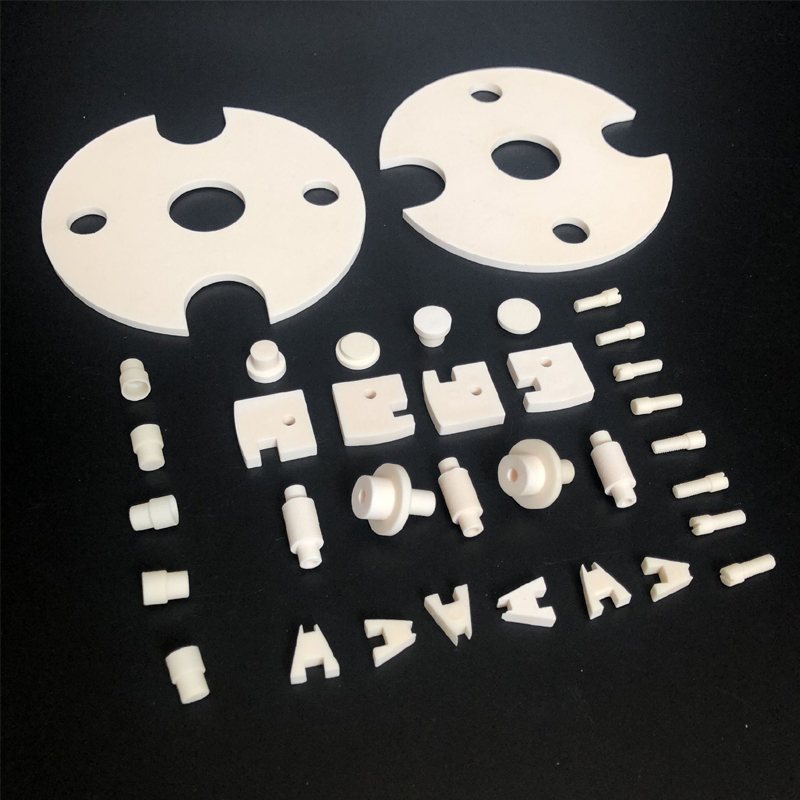
Mechanical stress damage: the most common direct cause of failure
During the equipment installation and commissioning phase, uneven bolt tightening torque applied by operators, collisions occurring during handling and assembly, and uneven stress on component mating surfaces will generate transient overload stress, which directly causes chipping and cracking of ceramic parts.
In long-term operation, high-frequency equipment vibration and continuous erosion and friction from materials subject ceramic parts to cyclic alternating stress, gradually resulting in surface abrasion and surface layer spalling, and eventually structural damage over time.
In addition, unreasonable product design, unpassivated edges and corners of parts, and stress concentration in equipment structures will significantly increase the risk of mechanical damage. These are major human-induced factors leading to premature failure of precision ceramic components.
Thermal shock alternating failure: core damage problem under high temperature conditions
Frequent temperature fluctuations cause repeated expansion and contraction of the internal grain structure of ceramics, enabling initial microcracks to continuously expand and propagate, gradually forming through cracks that ultimately lead to cracking and fracture failure of components.
Industry test data indicates that when the operating temperature difference exceeds 150°C with frequent thermal cycling, the service life of conventional alumina ceramic components is reduced by more than 40%.
Meanwhile, improper equipment start-stop procedures, abrupt shutdown and cooling of high-temperature machinery, uneven local heating and other operational issues aggravate thermal shock damage, serving as the primary triggers for equipment malfunctions under high-temperature working conditions.
Chemical media erosion: hidden chronic failure root cause
Various corrosive media can slowly penetrate the microporous structure on the ceramic surface and trigger mild chemical reactions with the alumina substrate. These reactions gradually erode grain boundaries and loosen the surface layer, resulting in surface pulverization, spalling, and a sharp drop in the mechanical strength of components.
After prolonged corrosion, the ceramic parts suffer comprehensive degradation in impact resistance, wear resistance and thermal shock resistance. Spontaneous cracking and breakage may occur even without obvious external force or temperature difference, which drastically shortens the service life of the parts and poses hidden safety hazards to equipment.