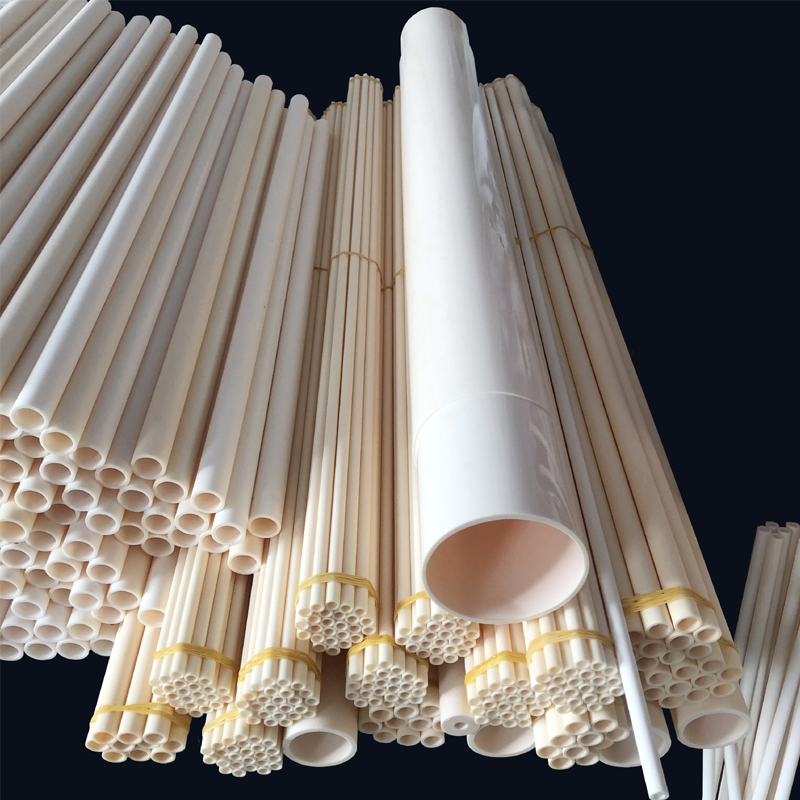
As industrial manufacturing transforms toward high-end and precision development, alumina ceramic tubes have become key basic components in chemical engineering, metallurgy, electronics, new energy and other fields, thanks to their core advantages such as high temperature resistance, corrosion resistance, high hardness and excellent electrical insulation.
However, the current market features a wide variety of alumina ceramic tubes, which can be divided into multiple series according to alumina content, production process, structural characteristics and other criteria. Many enterprises face confusion in procurement and selection. Blind selection not only leads to cost waste, but may also affect production efficiency and equipment stability.
In response, industry experts have compiled a scientific selection guide based on the current market situation and application scenarios, helping enterprises accurately match their needs, reduce costs and improve efficiency.
It is reported that alumina ceramic tubes are tubular industrial ceramic components mainly made of alumina (Al₂O₃) as the raw material, produced through processes including powder preparation, forming, high-temperature sintering, and precision machining. Their performance differences are mainly determined by three core factors: alumina content, sintering process, and raw material purity, which also serve as the key considerations for product selection. Among them, alumina content is the most critical distinguishing indicator. In the industry, mainstream products are classified into three grades: 95%, 99%, and 99.7% alumina content. Each grade shows a clear performance gradient and precisely meets the requirements of different working conditions.
Many companies mistakenly believe that the higher the alumina content, the better. This is not the case; the core of selection is adaptation to working conditions.
95% Alumina ceramic tubes belong to the general-purpose and economical category, featuring simple manufacturing processes and outstanding cost performance.
99% alumina ceramic tubes are medium-to-high end, high-performance products. By adding a small amount of sintering aids to optimize the production process, their temperature resistance is increased to 1600°C while keeping costs controllable, with significant improvements in hardness, wear resistance, and corrosion resistance.
99.7% ultra-high-purity alumina ceramic tube, as our high-end flagship product, features impurities strictly controlled at the ppm level and is sintered at temperatures as high as 1650–1700℃, offering exceptional high-temperature stability, high volume resistivity, and excellent dimensional accuracy.
Production processes and structural characteristics are also important references for selection. At present, extrusion molding combined with atmospheric pressure sintering is mainly adopted in industrial mass production, which is suitable for conventional large‑diameter and long‑size conveying pipes. For ultra‑high‑precision products, isostatic pressing combined with hot‑press sintering is used, which can control the dimensional tolerances of inner diameter, outer diameter and length within ±0.5–±3 mm, meeting strict requirements such as precision insulation and high‑end flow guidance.
- Dense alumina ceramic tubes emphasize mechanical properties and are suitable for applications such as sealing and transportation.
- Porous alumina ceramic tubes feature excellent adsorption and filtration performance, and can be used in environmental protection fields including wastewater treatment and gas purification.
Nano-alumina ceramic tubes overcome the "hard but brittle" drawback of traditional ceramics, showing broad application prospects in precision manufacturing, medical devices and other fields.
Industry insiders said that with the continuous advancement of alumina ceramic preparation technology, product categories will be further refined and performance will continue to be optimized. At present, China's alumina ceramic tube industry has formed a complete production and testing system, with product quality in line with international standards. Only by mastering scientific selection methods and accurately matching working condition requirements can enterprises give full play to the performance advantages of alumina ceramic tubes, reduce production costs and improve the operational stability of equipment.