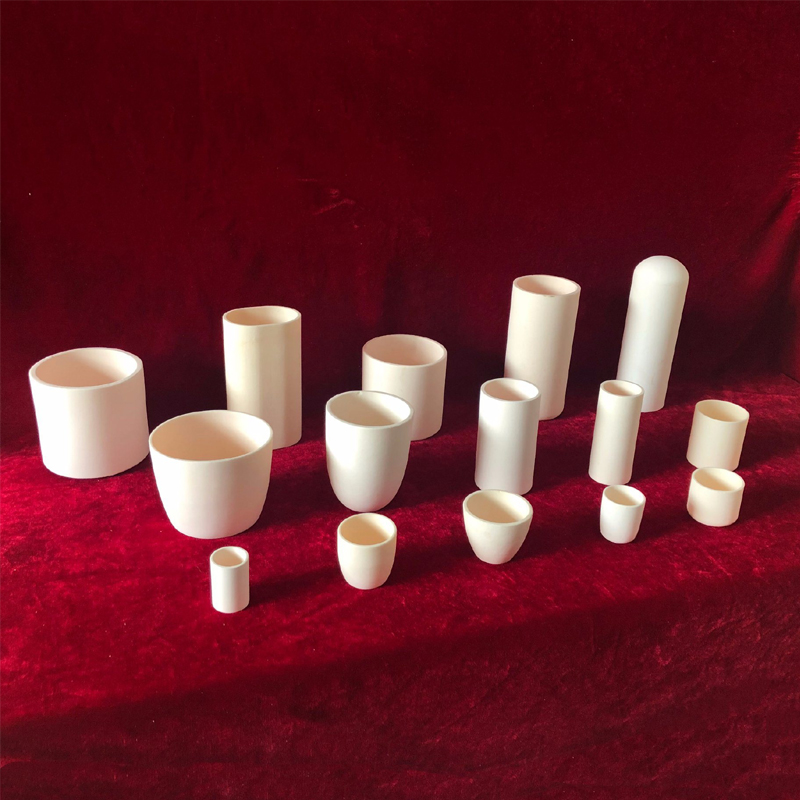
The overall superior material properties are the core foundation for the enduring popularity of alumina ceramics.
As a mainstream inorganic non-metallic ceramic material, alumina ceramic features core advantages of three highs and one excellence: high hardness, superior wear resistance, strong corrosion resistance and outstanding electrical insulation. It also boasts high temperature resistance, dimensional stability, biocompatibility and chemical inertness, making it applicable to various harsh and complex working conditions.
Alumina ceramics boast more prominent advantages in corrosion resistance and insulation performance.
Resists corrosion from 99% of common acid and alkali media (excluding hydrofluoric acid and hot concentrated phosphoric acid), suitable for corrosive working conditions in chemical and environmental protection industries. It boasts room-temperature resistivity exceeding 10¹³ Ω·cm and thermal conductivity of 28-40 W/(m·K), striking an optimal balance between thermal conduction and insulation, and fully meeting safety operation standards for electronic, electrical and high-voltage equipment.
Alumina ceramic features insulation, heat insulation and explosion-proof properties.
Widely applied in protective structures of power batteries, insulating parts of energy storage equipment and core components of photovoltaic modules, it safeguards the safe operation of new energy devices.
High cost performance and mature industrial system facilitate its large-scale popularization.
In the high-end ceramic material sector, advanced ceramics such as silicon carbide and silicon nitride boast superior properties. However, they suffer from scarce raw materials, complicated manufacturing processes and high costs, making large-scale popularization difficult. By contrast, alumina ceramics feature abundant raw material sources and mature purification and sintering techniques. Their production cost is merely one-third to one-fifth that of silicon carbide ceramics, granting them strong competitive edges in mid-to-high-end application scenarios.
Striking market data directly reflects the industry prosperity.
Industry research shows that the global market size of alumina ceramic substrates reached 3.23 billion US dollars in 2024, and is projected to rise to 3.46 billion US dollars in 2025. The market scale is expected to exceed 4.88 billion US dollars by 2030, with a steady compound annual growth rate of 7.09%.As a core production and consumption hub for alumina ceramics worldwide, China sees continuous output growth. Its products are upgrading toward high precision, high purity and functionalization, satisfying domestic high-end manufacturing demands and being exported in large volumes across the globe.