Exceptional hardness, wear and corrosion resistance build a strong "protective shield" for industrial applications.
One of the most remarkable characteristics of alumina ceramic parts is their ultra-high hardness and excellent wear resistance. With a Mohs hardness of up to grade 9, second only to diamond, they far outperform conventional wear-resistant steels and stainless steels. Alumina ceramics with purities of 95%, 99% and 99.5% exhibit Vickers hardness of 13.7GPa, 15.2GPa and 15.7GPa respectively, with a maximum compressive strength of 2350MPa and flexural strength of 350MPa.
Meanwhile, it features outstanding chemical stability, resisting erosion from various acid and alkali media without metal ion precipitation. It is suitable for harsh corrosive environments such as fine chemical industry and semiconductors, solving the industry pain points of easy corrosion and wear of traditional metal parts.
High temperature resistance and excellent thermal stability make it ideal for the "main battlefield" of extreme working conditions. Stable performance in extreme environments is another core advantage of alumina ceramic parts.
Its maximum operating temperature can reach 1650°C (under no load). Even under repeated high-temperature cycling, it maintains excellent dimensional stability, with a thermal expansion coefficient controlled at 7–8×10⁻⁶/°C (40–400°C) and thermal shock resistance up to 200°C, making it resistant to deformation, cracking and other failures.
Excellent insulation performance and stable physical and chemical properties empower electronics and precision manufacturing.Whether for integrated circuit substrates, electronic component packaging, new energy vehicle electronic control systems, or semiconductor electrostatic chucks, alumina ceramic parts can effectively insulate electric current and ensure circuit stability.Meanwhile, their excellent thermal conductivity — up to 32 W/(m·K) at 20 °C — enables rapid heat dissipation from electronic components during operation, preventing overheating damage, improving equipment stability, and extending service life.
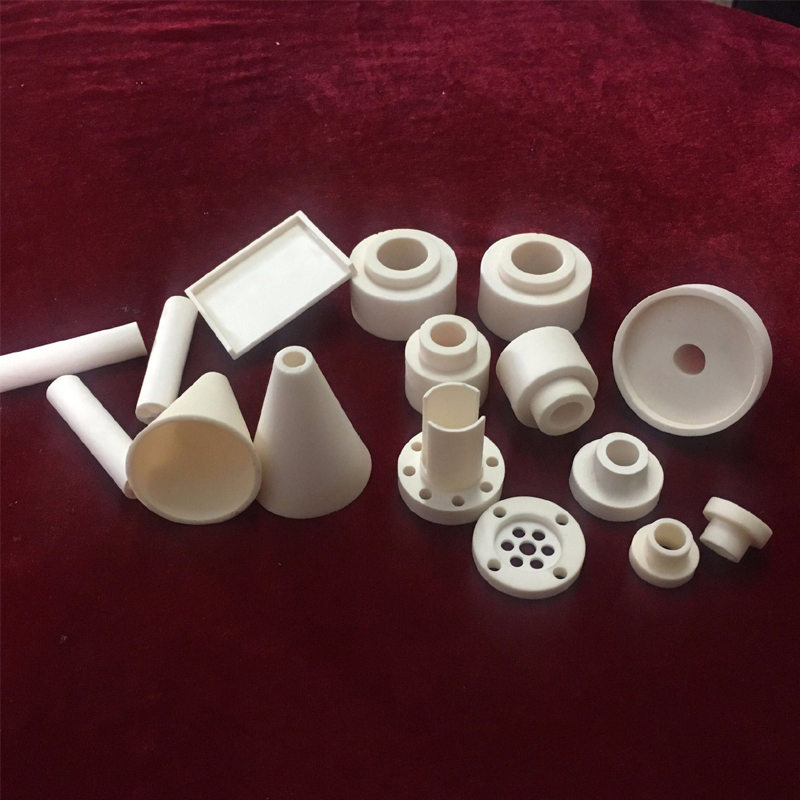
It features strong customizability and outstanding cost-effectiveness, expanding the boundaries of full-scenario applications. Unlike traditional ceramic parts, which are limited by high forming difficulty and single specifications, alumina ceramic parts can be produced through various processes such as dry pressing, slip casting, extrusion, and hot isostatic pressing. These adapt to custom requirements for different sizes and shapes. We can manufacture standardized alumina ceramic tubes, alumina ceramic rods, and alumina ceramic rings, as well as custom-shaped structures tailored to customer needs.