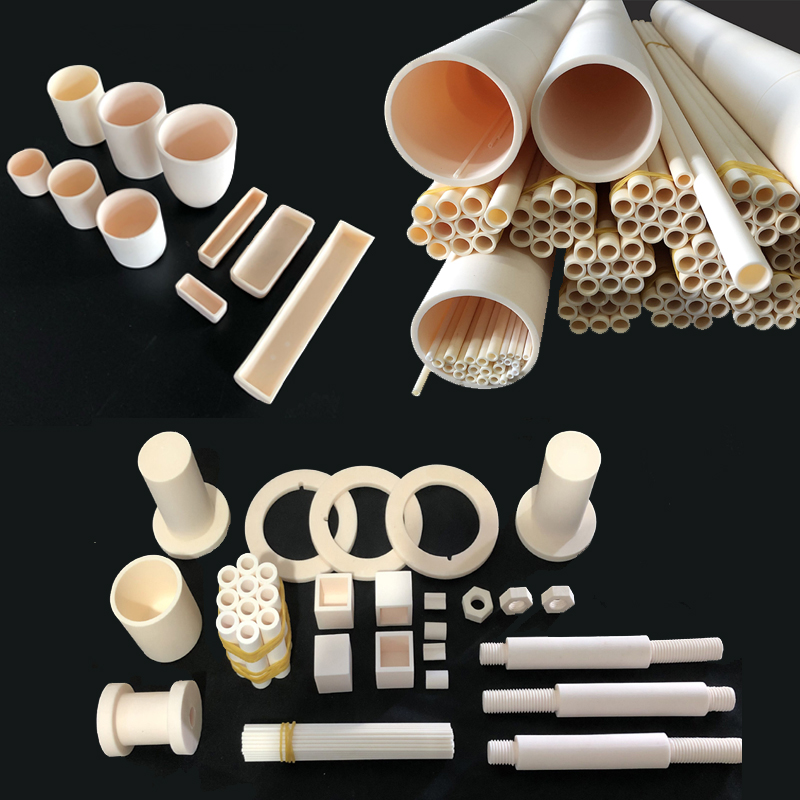
As a core category in the field of advanced structural ceramics, alumina ceramics break the application boundaries of traditional materials with their diverse and excellent properties. They have been widely adopted in key sectors including industrial manufacturing, semiconductors, biomedicine and new energy, emerging as a high-performance core material that drives industrial upgrading and addresses key technical bottlenecks. Recently, thanks to breakthroughs in multiple preparation technologies and the expansion of application scenarios, the outstanding characteristics of alumina ceramics have drawn renewed industry attention. Its unique performance advantages are continuously fueling new momentum for the development of various industries.
It boasts excellent mechanical properties, with superior wear resistance and compression resistance laying a solid foundation for diversified applications. The most renowned advantages of alumina ceramics are its exceptional hardness and wear resistance. With a Mohs hardness of grade 9, it ranks second only to diamond and cubic boron nitride, far outperforming traditional metals and ordinary ceramic materials. The Vickers hardness of standard ceramics only ranges from 400 to 700 HV, while medium and high-purity alumina ceramics can reach 1200 to 1800 HV. In scenarios such as mine conveying and mechanical processing, alumina ceramic-lined pipes feature a service life 5 to 10 times longer than that of steel materials. They effectively resist scouring and abrasion caused by high-speed slurry, greatly cutting down equipment maintenance costs.
Meanwhile, it delivers outstanding compressive strength and a high elastic modulus, resisting bending and deformation and maintaining precise dimensional stability. Widely adopted in precision load-bearing components including ceramic bearings and mechanical seals, it addresses the pain points of easy wear and deformation inherent in conventional materials.
Stable chemical properties and corrosion-resistant inertness enable adaption to extreme environments.
Alumina ceramics feature excellent chemical stability and can effectively resist strong acids, strong alkalis and various organic solvents, with the exception of hydrofluoric acid. Compared with corrosion-prone metal materials and ordinary silicate ceramics, they deliver outstanding advantages in the chemical industry. Widely used for manufacturing reactor linings, pumps, valves and other components, they ensure production safety and prevent medium contamination.
It features excellent thermal and electrical properties, perfectly meeting the demands of high-end industries. In terms of thermal performance, alumina ceramics boast a melting point of up to 2050°C. High-purity products can operate stably for a long time under high temperatures ranging from 1600°C to 1800°C, far exceeding the maximum service temperature of 800°C for ordinary ceramics.
With a low coefficient of thermal expansion, it undergoes minimal dimensional changes under drastic temperature fluctuations and delivers outstanding thermal shock resistance. It is widely applied in high-temperature scenarios such as high-temperature furnace linings, spacecraft heat insulation tiles, and high-pressure sodium lamp luminous tubes.