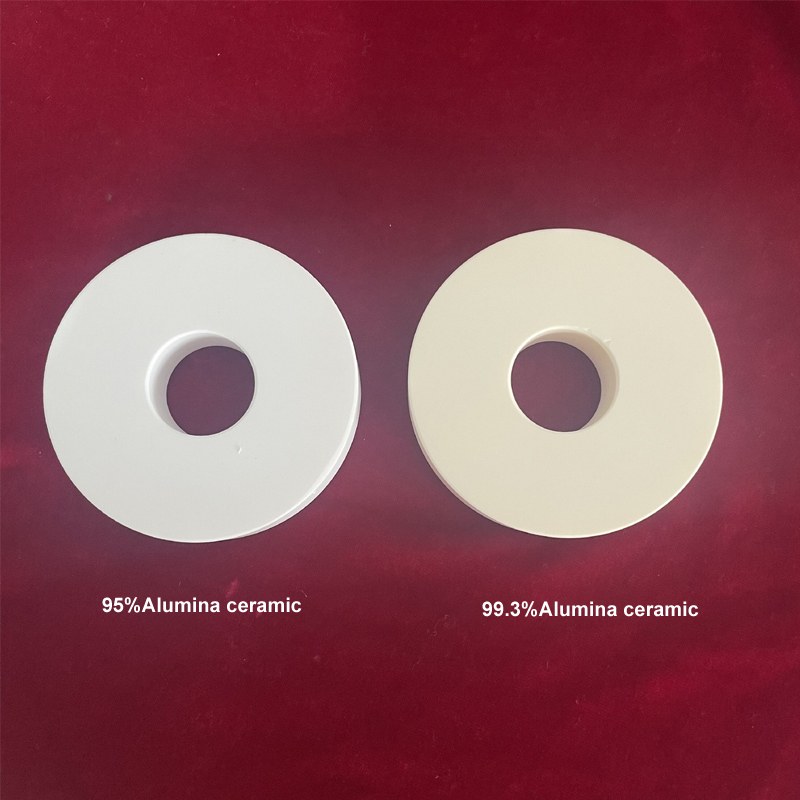
Because alumina ceramic has many distinctive properties, it can be made into many different products. For example, because of its high mechanical strength, it can be used as a mechanical structural part, and with its high resistivity and electrical insulation properties With good advantages, alumina ceramic has become an ideal material for products such as substrates, tube sockets, and circuit casings.
Alumina ceramics are also divided into different types. Among them, more than 99% of alumina ceramics are made of high-purity alumina materials, coupled with a series of related strict process guarantees, and the performance is more superior. Compared with 99% alumina and 95% alumina Alumina has higher density and higher bending strength.
Compared with 95% alumina ceramics, more than 99% alumina ceramics have the advantages of compactness and microstructure, which are reflected in the performance and cost-effectiveness, and are suitable for parts with higher performance requirements and moderate prices. 95% alumina ceramics use pure alumina materials and diversified preparation processes, while ensuring the characteristics of alumina ceramics, continuously reducing manufacturing costs.
As a result, 95% alumina ceramics has a lower performance index than 99% high-purity materials, and its density is slightly lower, which is suitable for less demanding parts.
Industry analysts point out that the industrial ceramics sector is currently shaped by a development landscape featuring "homogenization at the low end and scarcity at the high end". The market for regular alumina ceramics with a purity of 95% and below is plagued by cutthroat competition and severe product homogenization, resulting in continuous compression of profit margins. In contrast, high-purity alumina ceramics with purity above 99% hold the core share of the high-end market thanks to formidable technical and performance barriers. Driven by the rapid growth of domestic high-end equipment, semiconductor and new energy industries, market demand for such products keeps expanding, leaving immense room for import substitution.
Industry insiders point out that the core competitive focus of the alumina ceramics industry in the future will center on high purity, high precision and high stability. With continuous breakthroughs in material purification technology and precision sintering processes, the industrial application of 99.9% ultra-high-purity alumina ceramics will further accelerate, gradually breaking overseas technological monopolies and serving as a pivotal basic material underpinning the upgrading of China’s high-end precision manufacturing sector. In contrast, alumina ceramics of standard purity will remain targeted at general industrial scenarios, relying on cost performance and large-scale production as their core competitive edges. This will foster a tiered industrial landscape featuring coordinated development of high-end and mainstream product lines.