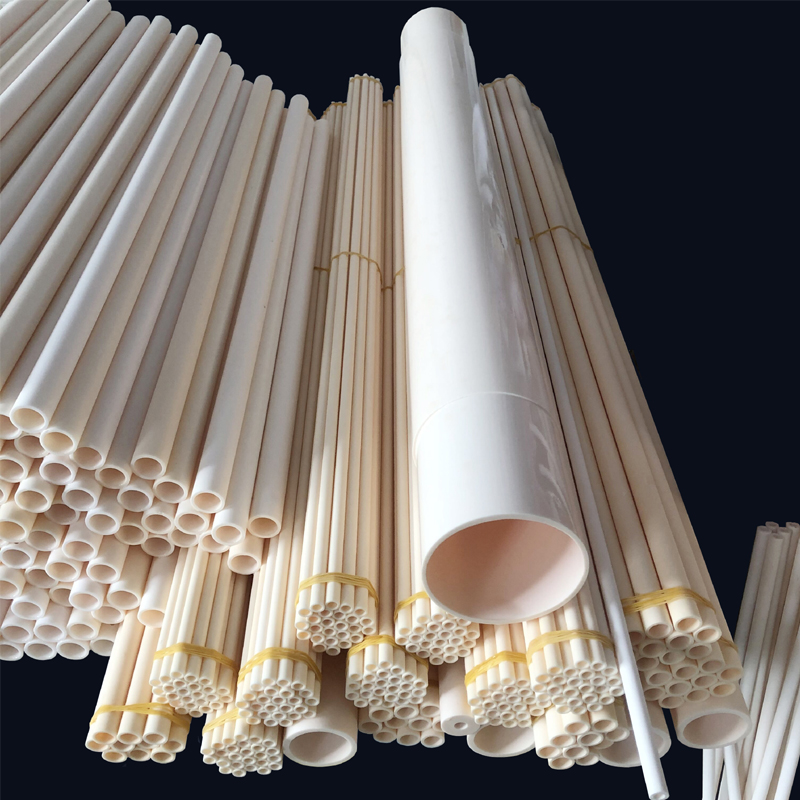
With ultra-high hardness, excellent insulation, strong corrosion resistance and outstanding thermal stability, high-purity alumina ceramics have become core key materials for high-end fields including semiconductors, aerospace and new energy. Recently, China has achieved full-industry technological breakthroughs in raw material preparation, sintering process, performance optimization and application expansion of high-purity alumina ceramics. It is gradually breaking overseas monopoly and driving leapfrog industrial development toward higher purity, superior performance and lower cost.
Raw material preparation:
High-purity raw materials form the core foundation of high-purity alumina ceramic performance. The industry has now achieved stable mass production of ultra-high purity powder with purity of 4N level (99.99%) and above.
Sintering process:
Innovative low-temperature sintering formula: The sintering temperature of 99% alumina ceramic is reduced to below 1530℃, a drop of over 100℃. Its flexural strength rises by more than 100MPa with greatly improved wear resistance. The microcrystallization effect enables a more uniform and compact microstructure.
Iteration of novel densification technologies: Cold sintering achieves powder densification under high pressure of 350~500MPa and low temperature of 120~300℃, greatly cutting energy consumption. Flash sintering realizes rapid sintering via external electric field and restrains grain coarsening. Oscillatory pressure sintering promotes grain rearrangement by dynamic pressure and eliminates residual pores.
Performance and Application:
Semiconductor industry: High-purity alumina serves as a core component of etching and deposition equipment for 3nm and more advanced processes. It is applied to optical monitoring windows, insulating rings, precision handling arms and other parts. Featuring resistance to halogen plasma corrosion, it can operate continuously for 8,000 hours without performance degradation.
Aerospace and new energy: High-purity alumina ceramic substrates match electronic payloads of spacecraft and ensure in-orbit reliability. They are used for IGBT heat dissipation substrates, relay housings and other components in high-voltage systems of new energy vehicles.
Industry Trends:
China's high-purity alumina ceramic industry presents three major development trends. First, ultra-high purity is pursued, with 4N-grade (99.999%) powder becoming the standard for high-end applications. Second, composite materials are developed to expand dielectric, optical and other special properties via ion doping and whisker toughening. Third, production capacity expands on a large scale. Leading enterprises cooperate with universities to set up specialized laboratories, solve problems such as cracking during forming of large-sized thin-walled parts, and build an integrated layout of technology, production capacity and industrial ecosystem.