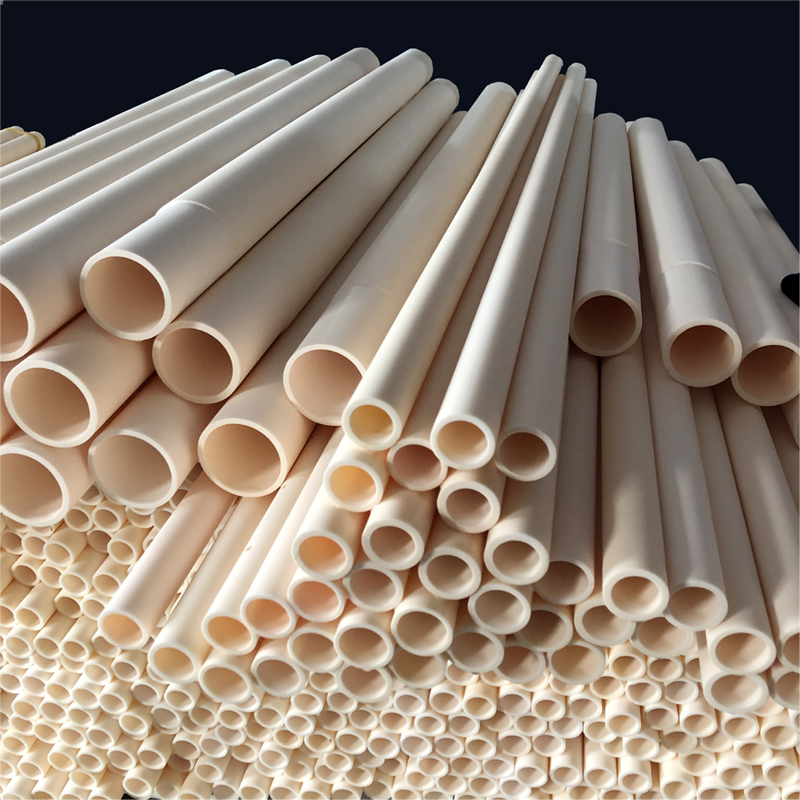
Ultimate performance, building a solid production safety defense line
The core competitiveness of alumina tubes lies in their excellent material properties, which is also the core logic that buyers prioritize. Its main component, alpha alumina, has a purity of up to 99.9%. After high-temperature sintering at 1800 ℃, it forms a dense structure with a Mohs hardness of up to level 9, second only to diamond. It has three core performance advantages:
The high temperature resistance performance far exceeds that of traditional metal pipe fittings, which can work stably for a long time in an environment of 1600 ℃, and can even withstand thermal shock of 1800 ℃ in the short term, while the high temperature resistance limit of ordinary metal pipes is only 1200 ℃. This characteristic makes it indispensable in extreme scenarios such as high-temperature metallurgy and rocket engine fuel transportation. After Baosteel Special Steel replaced traditional graphite crucibles with alumina composite tubes, the melting life of titanium alloy has exceeded 50 heats to 300 heats, completely solving the pain point of frequent consumables replacement.
The anti-corrosion ability can be called an "industrial fortress", with excellent inertness to 99% acid-base solutions, molten metals, and halogen gases except hydrofluoric acid, without rusting or oxidation. In the high-temperature diffusion process of semiconductor wafers, the Fe and Ni ions released by traditional metal tubes can seriously contaminate the chips, while alumina tubes can reduce the contamination rate to below 0.1ppm.
The advantages of insulation performance and cleanliness are significant, with a resistivity of up to 10 ¹⁴Ω· cm, a dielectric strength of up to 25KV/mm, and zero metal ion precipitation, meeting the requirements of semiconductor grade cleanliness and high-voltage insulation scenarios.
Wide adaptability across multiple industries, covering high-end manufacturing core scenarios
The performance advantages of alumina tubes enable them to accurately match the needs of multiple high-end manufacturing fields, becoming a "universal high-performance component" across industries, which is also an important reason for buyers to choose. According to industry reports, its applications have covered more than 20 industries such as semiconductors, new energy, high-temperature metallurgy, aerospace, pharmaceuticals, and chemicals. The global market size is rapidly expanding at a compound annual growth rate of 8.5%, and is expected to exceed 30 billion yuan by 2030.
Even in the field of scientific research, 99.7% high-purity alumina ceramic tubes have become the core components of vacuum experiments and high-temperature transmission systems due to their low porosity (less than 0.1%) and high density (true density 3.9g/cm ³). Their flexible form design (double opening, bottom sealing, thin-walled capillary tube, etc.) can meet the customized needs of different scientific research equipment.
Cost effectiveness and supply chain advantages are highlighted, reducing procurement decision-making risks
For buyers, besides excellent performance, cost control and supply chain stability are equally crucial. Although the initial procurement cost of alumina tubes is higher than that of ordinary metal pipes, the long-term comprehensive benefits are significant. Taking the chemical industry as an example, by replacing traditional stainless steel pipes with alumina tubes, the downtime losses caused by corrosion are reduced by 90%, the frequency of pipeline replacement is reduced by 70%, and the overall cost can be reduced by more than 40%.
From a supply chain perspective, China, as the world's largest producer of alumina tubes, accounts for over 40% of global production. Domestic leading enterprises have achieved product quality that is in line with international standards through advanced processes such as isostatic pressing and micro arc oxidation, while providing flexible customization services and fast delivery capabilities.
In addition, domestic alumina tube enterprises generally pass the ISO 9001 quality management system and RoHS environmental certification. Some high-end products also comply with international standards such as ASTM C799 and ISO 6474. Buyers can verify product quality through third-party testing reports (such as ICP-OES purity analysis) to reduce procurement risks.
Industry trends drive demand upgrading, and aluminum oxide tubes have become essential for industrial upgrading
Currently, the acceleration of the global transition from old to new kinetic energy, the explosive growth of emerging industries such as new energy and semiconductors, and the upgrading needs of traditional industries are jointly driving the continuous increase in demand for alumina tubes. In the field of new energy, the domestic production capacity gap of solid-state battery separator materials alone will reach 12000 tons by 2025, and alumina tubes are the core components of the high-temperature sintering process for separator production; In the process of semiconductor localization, the expansion of wafer manufacturing capacity directly drives the procurement demand for high-purity alumina tubes.
Purchasing tip: When choosing alumina tubes, the purity level should be matched according to the application scenario, and attention should be paid to sintering process and surface treatment technology to ensure accurate matching between the product and production needs.
Conclusion: From breakthroughs in performance under extreme working conditions to extensive adaptation across multiple industries, from long-term optimization of cost-effectiveness to stable supply chain guarantees, the comprehensive advantages of alumina tubes make them the preferred procurement choice in the era of high-end manufacturing. With the continuous iteration of technology and the expansion of application scenarios, choosing alumina tubes is not only a decision for component procurement, but also an important layout for enterprises to enhance their core competitiveness.