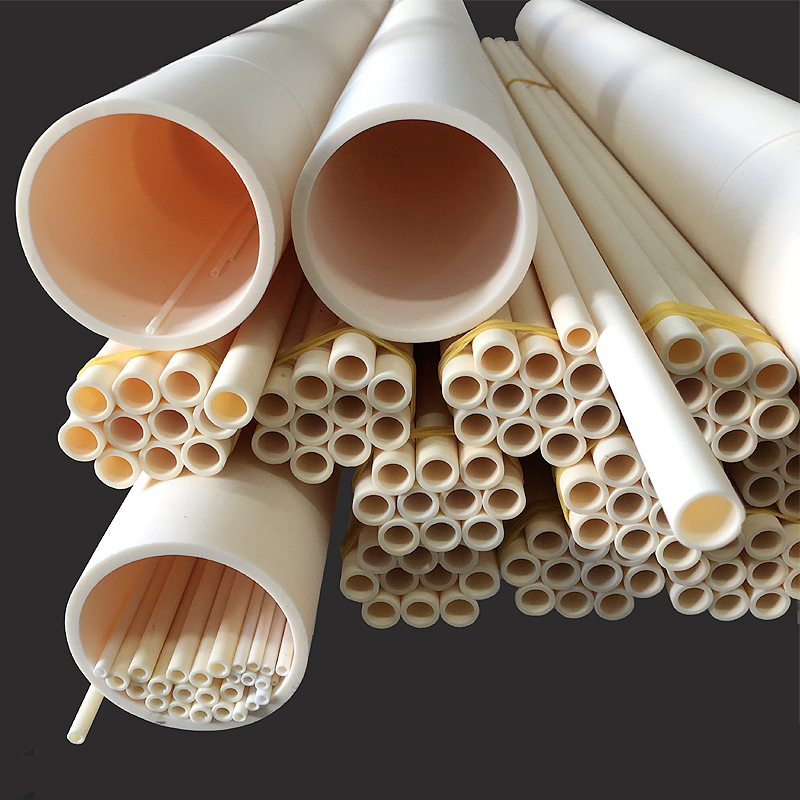
The industrial research team focuses on four aspects: material modification, process optimization, structural innovation and surface strengthening. It has developed a mature technical system to improve thermal shock resistance, effectively solving the reliability challenges of AL2O3 ceramics under high-temperature service conditions.
1. Second-phase doping modification is the mainstream core technology to improve the thermal shock resistance of AL2O3 ceramics.
It has been widely applied on a large scale thanks to its low cost and high compatibility.Scientific research shows that single alumina matrix structure features high brittleness and poor thermal stress buffering capacity. Introducing functional second-phase particles can optimize the matrix structure at the microscopic level and achieve toughening and crack resistance.
2. Refined optimization of preparation technology is the key method to reduce internal defects and consolidate the foundation of thermal shock resistance.
Traditional forming and sintering processes tend to cause concentrated internal pores, uneven grain size and excessive residual stress in ceramics, which are major triggers for thermal cracks.In the forming process, the industry is gradually phasing out conventional die pressing and widely adopting isostatic pressing technology. This ensures uniform stress distribution and dense structure of green bodies, eliminates local porosity defects and improves the overall structural stability of materials.In the sintering process, researchers have optimized a segmented precise sintering regime. By slow heating and cooling, and accurate control of maximum sintering temperature and holding time, thermal stress caused by rapid temperature fluctuation is avoided, excessive grain coarsening is restrained effectively, and grain boundary defects are reduced.
3. Precise microstructure regulation and prestress strengthening technology provide an innovative approach to improving the thermal shock resistance of AL2O3 ceramics.
The research team innovated multi-stage particle gradation technology. Adopting a composite gradation mode of coarse corundum, fine corundum and micropowder, it optimizes the internal packing structure of ceramics, disperses stress concentration points and prevents local stress overload cracking under thermal shock.
4. The iteration of new surface modification technologies further expands the application scope under extreme working conditions.
For harsh service conditions such as high-temperature water cooling and drastic temperature fluctuations, the research team developed nano-hydrophobic coating modification technology. It alters the surface heat exchange mechanism of AL2O3 ceramic by forming a nano-hydrophobic coating on its surface.