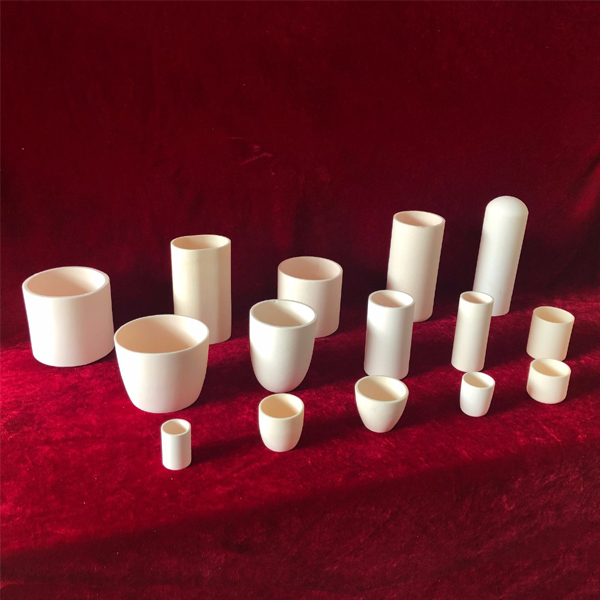
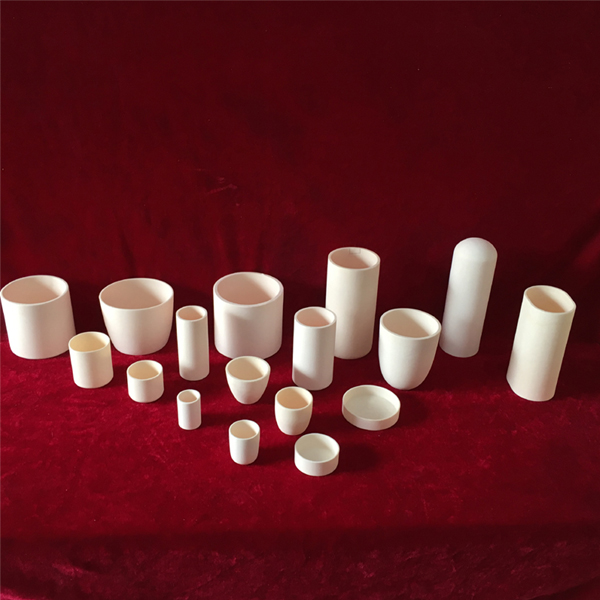
Thanks to its core advantages of excellent high-temperature resistance, corrosion resistance and low impurity precipitation, alumina ceramic crucibles have been widely used in semiconductor, metallurgy, scientific research and other fields in recent years. With technological innovation and industrial upgrading, their product performance has been continuously optimized and market demand has risen steadily, making them an important support for the high-quality development of the high-temperature material industry.
Alumina ceramic crucibles are high-performance refractory vessels made from high-purity alpha-alumina as the core raw material and sintered at high temperatures. Their key advantage lies in exceptional high-temperature resistance: with a melting point of up to 2050℃, they can operate stably at 1650℃ for long-term use and withstand extreme high temperatures of 1800℃ for short periods, far outperforming traditional crucible materials such as quartz and metals.
In addition, they feature excellent chemical inertness and do not react with most molten substances. The impurity precipitation rate can be as low as 0.02 ppm, effectively preventing contamination of the processed materials. This characteristic renders them irreplaceable in applications demanding ultra-high cleanliness, including the preparation of high-purity materials and the purification of precious metals.
In terms of application scenarios, alumina ceramic crucibles are widely used across numerous key fields.
In scientific research and experiments, they serve as a reliable assistant for chemical analysis and material synthesis, applicable to operations such as sample ashing, sulfate ash determination, and high-temperature solid-phase reactions. They provide researchers with a stable and dependable experimental environment, supporting the research and development of new materials and technologies.
In industrial production, they are extensively used in metal smelting, semiconductor wafer growth, glass manufacturing, electronic ceramic component firing, and other processes. Particularly in the semiconductor industry, they meet the requirements for high-purity oxide precursor calcination, safeguarding core processes in chip manufacturing.
Furthermore, in jewelry making, scrap metal recycling and other sectors, alumina ceramic crucibles, with their stable performance, have become ideal vessels for precious metal melting and scrap metal refining.
Industry data shows that in 2023, domestic high-purity alumina ceramic crucibles accounted for 58.7% of the market, with an annual consumption of approximately 123,000 units. Driven by the rapid expansion of emerging industries such as semiconductors and new energy, market demand has continued to rise.
To meet industry demand and address technical challenges, relevant domestic enterprises and research institutions have continuously increased R&D investment, promoting technological iteration and product upgrading of alumina ceramic crucibles.