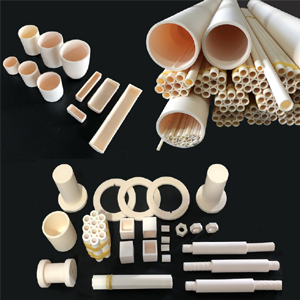
Thanks to its advantages of high temperature resistance, good insulation and high mechanical strength, alumina ceramics have become core fundamental materials in fields such as electronic packaging, high-temperature kilns and new energy. As a key indicator for measuring its thermal conductivity, thermal conductivity has long been regarded by many practitioners as "the higher the better", and has even become the sole criterion for enterprise material selection. However, multiple material companies and laboratories, combined with the latest industry test data, have found that a higher thermal conductivity of alumina ceramics is not necessarily better. Its selection should be deeply matched with application scenarios and take into account multi-dimensional performance balance. Blindly pursuing high thermal conductivity may instead lead to cost waste, performance imbalance and other problems.
Thermal conductivity refers to the amount of heat transferred per unit area per unit time, with the unit of W/(m·K). A higher value indicates a faster heat conduction rate, and this characteristic indeed has irreplaceable value in specific applications.
In fields with stringent heat dissipation requirements such as AI chip packaging, high-power IGBT modules, and LED substrates, high-thermal-conductivity alumina ceramics have become the key to breaking through heat dissipation bottlenecks.
High thermal conductivity is not suitable for all scenarios. Blindly pursuing high values may instead lead to misunderstandings in material selection. In applications such as low-temperature heat insulation and thermal protection, an excessively high thermal conductivity can become a shortcoming.
For example, if high-thermal-conductivity alumina ceramics are used in the insulation layer of industrial high-temperature kilns, heat will dissipate rapidly, which not only reduces the thermal efficiency of the kiln but also increases energy consumption. In low-temperature storage equipment, the high thermal conductivity property will disrupt the internal low-temperature environment and impair equipment performance.
Industry experts point out that such scenarios are more suitable for alumina ceramics with low thermal conductivity. Through reasonable porosity design, air pores can hinder heat transfer and meet the core demand of thermal insulation. In these cases, low thermal conductivity is actually more advantageous.
More importantly, improving the thermal conductivity of alumina ceramics is often accompanied by compromises in other properties and a sharp increase in cost. In terms of material characteristics, thermal conductivity is closely related to purity, crystal structure, and porosity: higher purity, larger grain size, and lower porosity result in higher thermal conductivity, but this also leads to increased brittleness, greater processing difficulty, and reduced mechanical toughness.
Industry insiders appeal that when enterprises select alumina ceramic materials, they should abandon the one‑sided view that "the higher the thermal conductivity, the better". Instead, they should comprehensively consider factors including thermal conductivity, mechanical strength, insulation performance, and cost based on the core requirements of their own application scenarios. For material manufacturers, it is necessary to focus on scenario‑based demands and develop differentiated products. They should not only break through technical bottlenecks in high thermal conductivity to meet the needs of high‑end fields, but also optimize the performance of conventional products and provide cost‑effective solutions.