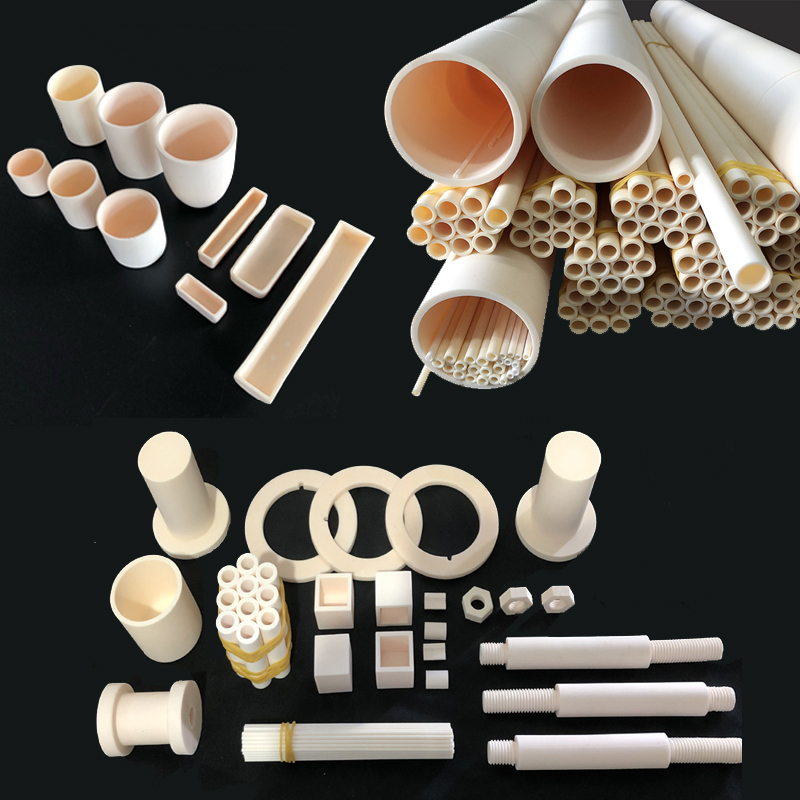
Alumina ceramics are known as the "teeth of industry". With a Mohs hardness of up to 9, their wear resistance is 266 times that of manganese steel, and they can operate stably for a long time at a high temperature of 1400℃. However, their shortcomings such as high brittleness, high sintering temperature, and difficult processing of complex structures have long restricted their large‑scale application.
In recent years, research institutions and enterprises have carried out collaborative research. The implementation of a series of improved processing technologies has completely solved this industry dilemma. Low‑temperature sintering technology, through the optimization of a composite sintering additive system, reduces the sintering temperature of 99% alumina ceramics from the traditional 1800℃ to below 1450℃, greatly lowering energy consumption while improving material density. Breakthroughs in forming processes such as 3D printing and injection molding have enabled the precise fabrication of complex and special‑shaped components.
In the automotive electronics industry, advancements in processing techniques have made alumina ceramic a "key enabler" for the upgrading of new energy vehicles. As automobiles transition toward electrification and intelligence, the requirements for thermal conductivity and stability of materials in electronic control units (ECUs) and battery thermal management systems have increased significantly.
In the aerospace and semiconductor sectors, advancements in precision machining technology have enabled alumina ceramics to achieve "extreme applications".
The aerospace industry imposes stringent requirements on materials for light weight, high-temperature resistance, and tolerance to extreme temperature differences. The improved machined alumina ceramic insulation tiles weigh only one-third of metal components and can withstand temperatures as high as 1600°C.
In the field of high-end equipment manufacturing, breakthroughs in alumina ceramic processing technology have achieved a major milestone in import substitution.
Industry insiders noted that every improvement in alumina ceramic processing methods has continuously expanded its application scope. At present, green manufacturing and intelligent processing have emerged as new trends in the industry.The water‑based tape casting process, which replaces organic solvents, reduces VOC emissions by more than 90%. Five‑axis linkage precision engraving machines combined with AI algorithms have improved processing efficiency by 40%. These technological innovations have further enhanced the cost‑performance and market competitiveness of alumina ceramics.
It is projected that by 2030, the global market size of alumina ceramic substrates will reach 5 billion US dollars, with a compound annual growth rate of 8.5%. Among them, automotive electronics and LED lighting will account for more than 60% of total demand.