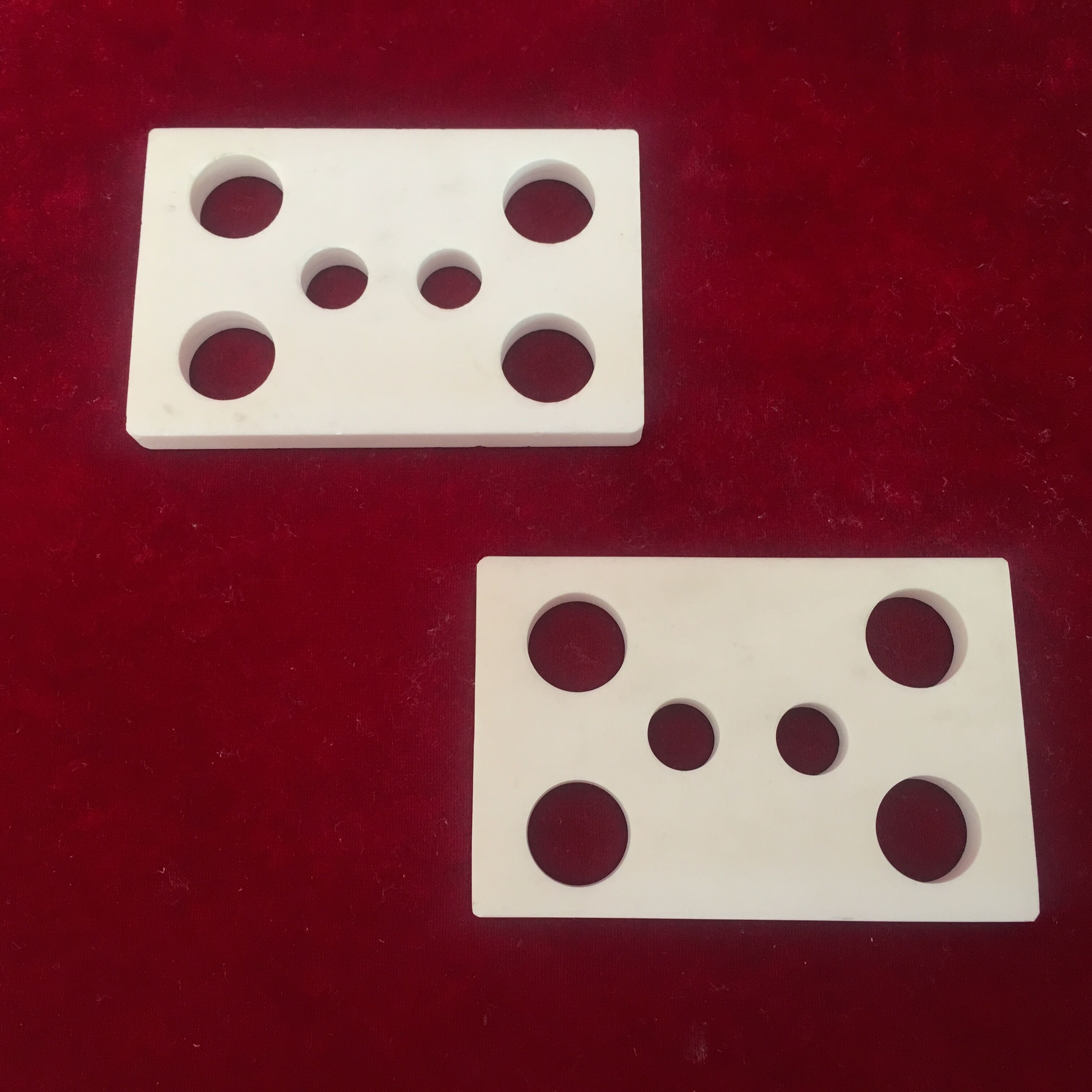
Initial Visual Screening: Identify Inferior Products at a Glance & Ensure Basic Quality
Visual inspection serves as the most convenient primary screening method, allowing quick detection of obvious defects without the need for professional tools. High-quality alumina ceramic sheets feature a flat, smooth surface with a fine, burr-free touch and a jade-like gentle luster. They are free from defects such as scratches, cracks, air pores, black spots, and edge chipping, with a uniform and consistent color.
Weight and Tap Test: Judging Compactness and Identifying Internal Defects
The density of alumina ceramic plates directly determines their performance. High-purity alumina has a density of approximately 3.6–3.8 g/cm³. For products of the same specification, ceramic plates with greater weight generally feature higher sintering compactness and lower porosity.
Buyers may select samples of identical dimensions for comparative weighing. Products that feel light and flimsy mostly fail to meet the required alumina content standard or suffer from insufficient sintering time, and are thus regarded as inferior products.
Simple Performance Test: Verify Hardness and Wear Resistance to Prevent Cutting Corners
Hardness is a core performance indicator of alumina ceramic plates and can be quickly verified through on-site scratch testing. Use an ordinary carbon steel tool (such as a wrench or screwdriver) to gently scratch the edges and corners of the ceramic plate. High-quality products will not leave obvious scratches—only slight white marks that can be wiped off. If deep scratches or chipping occur easily, it indicates substandard hardness and poor wear resistance, which cannot meet the requirements of industrial working conditions.
Qualification & Parameter Verification: Rigorous Control to Ensure Compliance
Visual inspection and simple testing only serve as preliminary identification; final judgment must be based on professional parameters and qualification reports.
Regular manufacturers are required to provide third-party inspection reports, with focus on verifying three core indicators: alumina content, bulk density, and Rockwell hardness. Meanwhile, parameters such as flexural strength, insulation performance, and corrosion resistance must comply with industry standards.
Priority shall be given to manufacturers with complete production qualifications and good industry reputations. Be wary of unqualified products without inspection reports, falsely marked parameters, or low-price dumping, so as to avoid production losses caused by penny-wise and pound-foolish decisions.
Expert Reminder: Scientific Identification Balancing Cost-Effectiveness and Practicality
Industry experts state that the identification of alumina ceramic plates shall follow the full-process logic of "appearance + density + performance + qualification". Quality shall not be judged solely by price or appearance. Enterprises may select products of corresponding purity based on actual working conditions, and establish a regular quality inspection mechanism. Through standardized identification methods, inferior products can be prevented from entering the production line from the source, ensuring stable equipment operation and reducing operation and maintenance costs.