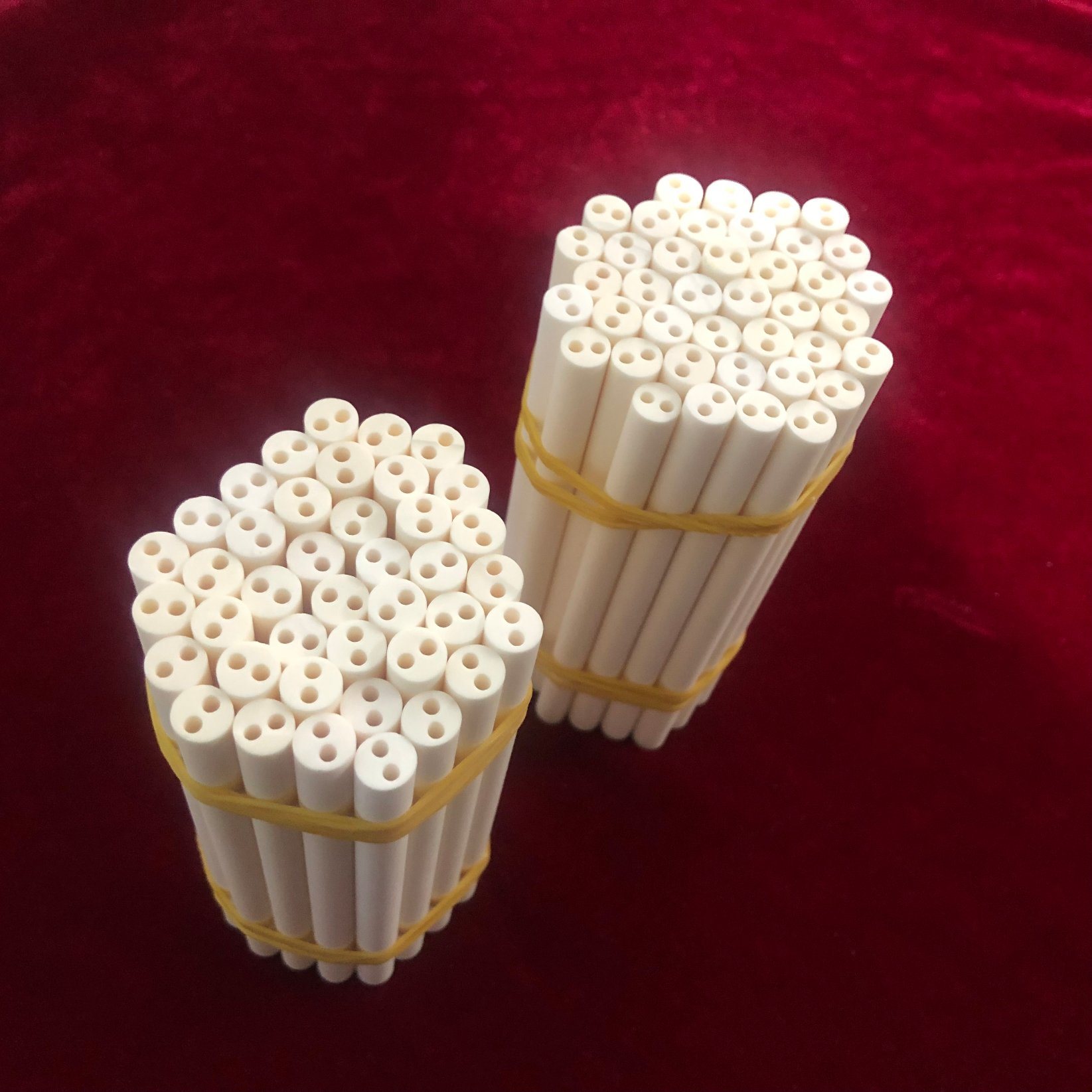
2‑hole alumina ceramic tubes are manufactured from high‑purity alumina (99.3%–99.7%) as the core raw material through precision forming and high‑temperature sintering processes. Featuring open ends and excellent verticality, they can withstand an extreme temperature of up to 1800°C and meet international standards including SGS and DIN series.The dual‑hole structure enables special functions such as fluid distribution, dual‑wire insulation, and synchronous sensing. Compared with single‑hole ceramic tubes, they offer stronger adaptability and practicability, and are widely used in thermocouple protection, fluid dispersion, catalyst support, sensor protection, and other applications.
It is reported that the proper use of 2-hole alumina ceramic tubes must follow the full-process standard of "pre-inspection – standardized installation – scientific operation – post-maintenance". Each step directly affects its service performance and service life, with specific key points as follows:
Pre-inspection is the fundamental prerequisite for safe use. As 2‑hole alumina ceramic tubes are fragile, they are prone to cracks caused by bumps and impacts during loading, unloading, and handling. Therefore, a comprehensive inspection must be carried out before use.
First, visually inspect the surface of the tube for any external defects such as breakage, cracks, or chipped corners. Second, gently tap the tube surface with a metal object. A clear, crisp metallic sound indicates no internal cracks; a dull sound suggests potential defects, and such tubes must be removed immediately and strictly prohibited from use.
Meanwhile, verify that the specifications of the tube match the application scenario, ensuring its outer diameter, bore diameter, length, and purity meet operational requirements. For example, high‑temperature applications require 99.7% high‑purity products, and corrosive environments demand compliance with chemical inertness standards.
In addition, during storage, the tubes should be placed in a ventilated and dry environment, sealed in packaging bags to prevent moisture absorption, contamination, and performance degradation.
Proper installation is critical to achieving optimal performance.Before installation, clean the installation interface to remove oil, debris, and rust, ensuring the interface is flat and clean. This prevents uneven stress on the tube caused by an uneven interface, which could lead to cracking.
During installation, handle the product with care to avoid excessive force or violent impact. Pay special attention to protecting both ends of the tube and the edges of the bores. Select appropriate seals and fasteners according to actual working conditions. The tightening force must be moderate: ensure a tight, secure connection without looseness, while avoiding over-compression that could damage the tube.For high-temperature and high-pressure applications, leave a certain thermal expansion gap during installation to prevent stress and cracking caused by thermal expansion and contraction under high temperatures.If used for thermocouple protection or dual-wire insulation, pass the lead wires or thermocouple wires smoothly through the dual bores, ensuring no friction between the wires and the inner walls of the bores to prevent wire abrasion or tube damage.
After installation, re-inspect all connections to confirm they are secure and properly aligned, and ensure the dual-bore channels remain unobstructed.
Scientific operation is the core guarantee for extending service life. During use, it is necessary to strictly control the operating environment parameters and avoid working conditions beyond the product's rated range. For example, the long-term service temperature of 99% purity 2-hole alumina ceramic tubes should not exceed 1600℃, and that of high-alumina products should not exceed 1400℃, so as to prevent softening, deformation or damage of the tube body caused by high-temperature overload.
Late maintenance and proper storage are important measures to reduce operating costs. During daily use, regular inspections of the 2‑hole alumina ceramic tubes should be carried out, focusing on the tube appearance, connection parts, and dual channels. If any cracks, damage, looseness, or blockage are found, the equipment must be shut down immediately to prevent further fault escalation.
After shutdown, the tube should be thoroughly cleaned to remove surface stains, deposits, and corrosive products. Once cleaned, it should be placed in a dry, well‑ventilated area free of debris, and must not be stored with hard objects to avoid impact damage. For long‑term storage, the tube should be packed in sealed bags for moisture and dust protection to prevent dampness and contamination.
Damaged tubes should be sorted, stored properly, and disposed of appropriately to avoid resource waste or environmental pollution caused by random discarding.
Currently, the application scope of 2‑hole alumina ceramic tubes continues to expand. Gradually extending from traditional metallurgical and chemical industries to high‑end fields such as semiconductor manufacturing, new energy batteries, environmental water treatment, and scientific research, their standard usage has drawn increasing attention across the industry.
We hereby remind all practitioners to strictly follow product usage standards and operating procedures, use them scientifically, and maintain them properly. This will enable 2‑hole alumina ceramic tubes to better empower efficient, safe, and green production in various industries and support high‑quality industrial development.