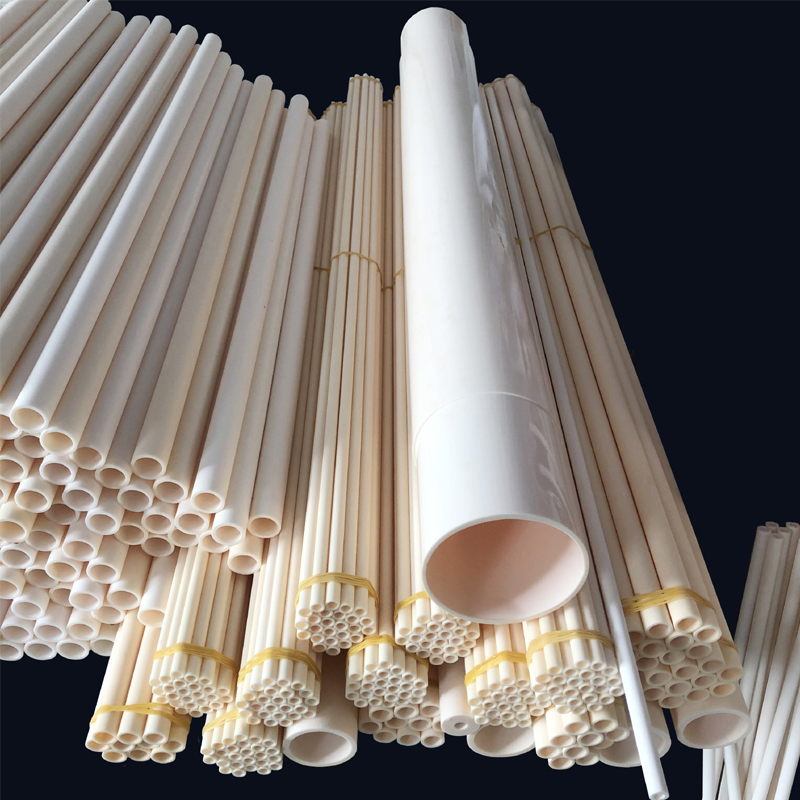
Amid the transformation of industrial manufacturing toward high-end and green development, the operational stability of equipment under high-temperature, high-pressure and strong corrosive working conditions has become the key for enterprises to cut costs and boost efficiency. Alumina ceramic tubes, leveraging their core advantages of high temperature resistance, corrosion resistance and high insulation, are gradually replacing traditional metal pipes and emerging as a key category of focus for purchasers across multiple industries such as chemical engineering, semiconductors, metallurgy and new energy.
As an indispensable functional component in the industrial field, alumina ceramic tubes are manufactured with high-purity alumina as the core raw material through powder preparation, high-temperature sintering and precision processing, and their performance directly determines the service life and operation efficiency of downstream equipment. Compared with traditional metal pipes, alumina ceramic tubes have particularly prominent advantages: products with a purity of over 99% can be used for a long time in a high-temperature environment of 1600℃, with a high resistivity of up to 10¹⁴Ω·cm and a dielectric strength of 25KV/mm. Meanwhile, they exhibit excellent corrosion resistance to 99% of acid and alkali solutions and molten metals, reach a Mohs hardness of Grade 9, and their wear resistance is more than 10 times that of ordinary metals, which can effectively solve the industry pain points of traditional pipes such as easy softening, corrosion and wear.
What merits buyers' attention is that a clear product gradient has taken shape in the current alumina ceramic tube industry, which can meet the differentiated demands of various procurement scenarios. The mainstream products in the industry are classified into three grades by alumina content: 95%, 99% and 99.7%. Among them, the 95% alumina products boast the highest cost performance, suitable for more than 80% of general industrial working conditions, with procurement costs 30% to 40% lower than those of 99% alumina products; the 99% alumina products are adapted to high-temperature, high-wear and strong-corrosion working conditions, making them the preferred choice for the chemical, metallurgical and other industries; the 99.7% ultra-high purity products focus on precision insulation and high-purity medium transportation, applicable to high-end scenarios such as semiconductors and scientific research experiments. They can effectively control the metal ion contamination rate and help improve the yield of downstream products.
For purchasers, how to select models accurately and avoid procurement pitfalls has become the key to improving procurement cost performance. Combining the pain points in procurement, industry experts put forward three core suggestions: First, accurately match the alumina content with the working conditions to avoid cost waste caused by blind pursuit of high purity. Products with 95% alumina content are suitable for general working conditions, while ultra-high purity products with 99.7% alumina content are the first choice for high-end and precision scenarios. Second, strictly verify the product inspection reports and require suppliers to provide test data complying with ASTM or GB/T 3299-2022 standards, with a focus on core indicators such as temperature resistance, hardness, corrosion resistance and thermal shock stability. Third, give priority to suppliers with full industry chain production capacity and successful project cases. Such enterprises not only provide more guaranteed product quality, but also offer integrated solutions from material selection to process optimization, lowering the threshold for application.
We remind all purchasers that the quality of alumina ceramic tubes on the current market is uneven. When making purchases, it is essential to carefully verify suppliers' production qualifications, technical capabilities and project references, and select the right models in line with your actual working conditions. Only in this way can you achieve the dual goals of cost reduction and efficiency improvement as well as stable equipment operation. In the subsequent industry-related exhibitions and technical exchange conferences, more leading enterprises will showcase new products and solutions, providing purchasers with more intuitive model selection references and cooperation opportunities.