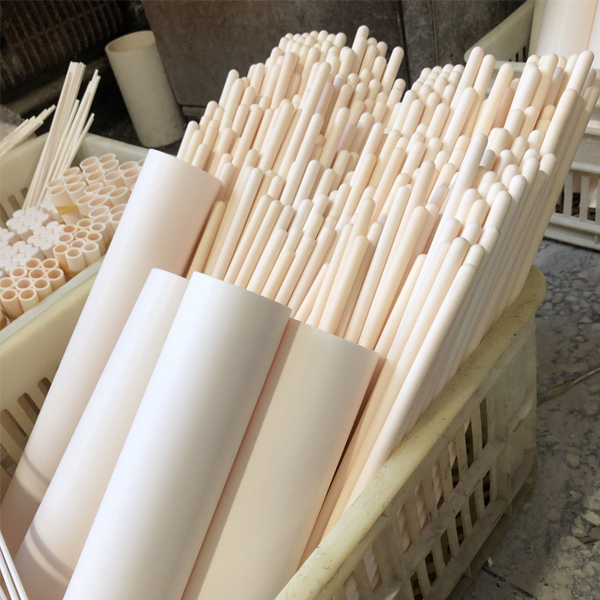
Alumina ceramic tubes are widely used in chemical engineering, metallurgy, semiconductors, new energy and other fields due to their high hardness, high temperature resistance, wear resistance and electrical insulation. Density is the core indicator determining their mechanical properties, gas tightness and service life. This paper systematically elaborates the sintering principles and implementation approaches of high-density alumina ceramic tubes from key aspects such as powder selection, forming process, sintering schedule and atmosphere control, providing theoretical and technical support for the stable industrial preparation.
Ⅰ、The core scientific foundation of densification
The densification of alumina ceramics is essentially a synergistic process of particle rearrangement, pore elimination, grain boundary migration, and grain growth at high temperatures.
When the relative density is ≥ 95%: pores are significantly reduced, and the flexural strength and impact resistance are greatly improved.
When the relative density is ≥ 99%: it approaches the theoretical density (3.98 g/cm³), enabling excellent hermeticity and high insulation performance.
The core objective of sintering is to maximize the elimination of closed pores while suppressing abnormal grain growth.
Ⅱ、Key preparation process of high-density alumina ceramic tube
1. Powder and Formula Design (Prerequisite for Densification)
High-purity α-Al₂O₃ powder with purity ≥ 99% and particle size of 0.2–0.5 μm is adopted, featuring narrow particle size distribution and good dispersibility.
Sintering aids such as MgO, Y₂O₃ and SiO₂ are added appropriately to lower the sintering temperature and inhibit grain coarsening.
The solid content and dispersion system of the slurry are optimized to ensure favorable rheological properties and uniform forming.
2. Forming Process (Green density determines the sintering limit)
Cold Isostatic Pressing (CIP): Formed at 100–200 MPa, with uniform green density and few defects, making it the preferred method for fabricating long ceramic tubes.
Extrusion Molding: Suitable for mass production of tubular green bodies. The content of plasticizer and vacuum degassing must be strictly controlled to avoid delamination and pores.
The higher the green density, the more uniform the sintering shrinkage and the higher the densification efficiency.
3. Binder Removal and Pre-sintering (Avoid Cracking and Residual Carbon)
Step-temperature binder removal: room temperature to 400 °C at 3–5 °C/min, holding for 2–3 h to fully remove binders.
Medium-temperature pre-sintering: 800–1000 °C, holding for 1 h to strengthen green bodies and provide structural stability for high-temperature sintering.
Vacuum/air atmosphere is controllable to prevent black core and pores caused by residual carbon.
4. High-temperature sintering regime (the decisive step for densification)
(1) Atmospheric pressure sintering without pressure (mainstream industrial process)
Temperature: 1600–1680 °C;
Heating rate: ≤ 2 °C/min in the high-temperature stage;
Holding time: 2–4 h;
Advantages: low equipment cost, suitable for long tubes and mass production;
Key points: temperature control accuracy ±5 °C to prevent local over-firing and grain growth.
(2) Two-step sintering (fine-grained and high-density)
First step: Rapid heating to 1550–1600 °C to initiate densification;
Second step: Cooling to 1400–1450 °C and holding for a long time, achieving densification without grain growth;
Advantages: Relative density can reach more than 98%, grain size < 2 μm.
(3) Advanced Sintering Technologies (Ultra-high Density)
Hot Pressing (HP): 1500–1550 °C, 20–40 MPa, density >99.5%;
Hot Isostatic Pressing (HIP): High temperature + isostatic pressure, with complete elimination of closed pores, suitable for high-end hermetic ceramic tubes;
Limitations: High equipment investment, mainly used in high-precision and high-reliability applications.
5. Sintering Atmosphere Control
Air sintering: suitable for conventional 95 alumina ceramics and 99 alumina ceramics;
Vacuum / hydrogen sintering: reduces oxygen vacancies, improves insulation and translucency, and decreases grain boundary phases;
Unstable atmosphere tends to cause: grain boundary impurity enrichment, reduced density, and deformation or cracking of the tube.
Ⅲ、Typical Process Parameters (Direct Reference for Industrialization)
Powder: 99.5% α-Al₂O₃, d50 = 0.3 μm;
Forming: Cold isostatic pressing at 160 MPa;
Binder removal: 400 °C × 3 h;
Sintering: 1650 °C × 3 h, air atmosphere;
Target: Relative density 96%–98%, flexural strength 350–450 MPa, excellent hermeticity.
Ⅳ、Common Defects and Solutions
Low density: Improve powder activity, optimize holding time, and increase forming pressure.
Tube deformation: Caused by uneven green density, too fast heating rate, and unreasonable support; use isostatic pressing and optimize kiln furniture instead.
Cracking: Caused by insufficient binder removal and uneven shrinkage; adopt stepwise heating and slow cooling.
Ⅴ、Conclusion
The sintering of high-density alumina ceramic tubes is a systematic engineering involving multivariate coupling of powder, forming, temperature, pressure, and atmosphere. Through precise control over the entire sintering process, stable achievement of high density, fine grains, and low defects can be realized, which significantly improves the service life of ceramic tubes under high-temperature, corrosive, and high-pressure working conditions. In the future, combined with rapid sintering technologies such as microwave sintering and spark plasma sintering (SPS), low-temperature, short-time, and high-efficiency densification will be further realized, promoting the development of alumina ceramic tubes toward high-end, precision, and green-oriented applications.