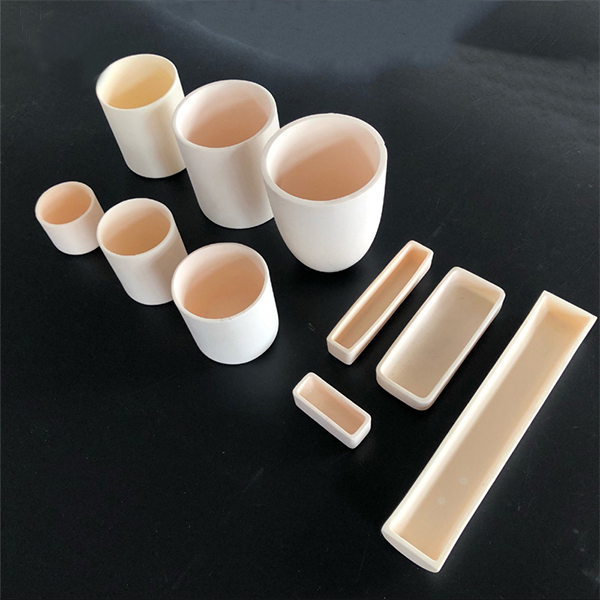
The core requirements of ceramic crucibles for high-temperature experiments focus on three dimensions: temperature resistance, chemical stability, and thermal stability. Alumina ceramic crucibles precisely meet these demands.
It is reported that alumina ceramic crucibles are made from high-purity α-alumina through high-temperature sintering. They can operate stably at temperatures below 1600°C for a long time and withstand an extreme high temperature of 1750°C in the short term—far exceeding the temperature limits of quartz and ordinary ceramic crucibles. This completely solves the problem of softening and deformation that commonly occurs in crucibles during high-temperature experiments.
Compared with other ceramic crucible materials, alumina ceramic crucibles exhibit particularly outstanding core advantages. They feature strong chemical inertness, showing almost no reaction to acids, alkalis, molten salts, and most metal melts. This effectively prevents experimental contamination caused by chemical reactions between the crucible and samples, ensuring the accuracy of high-precision experiments such as trace analysis.
Meanwhile, their low thermal expansion coefficient delivers excellent thermal shock resistance, enabling them to withstand rapid heating and cooling. Even when quenched from 1000 °C into room-temperature water, they are unlikely to crack, making them suitable for complex experimental scenarios including programmed temperature control.
In addition, high-purity alumina ceramic crucibles have extremely low impurity content, meeting the stringent requirements for clean environments in high-end fields such as semiconductors and electronics.
For different requirements of high-temperature experiments, there are clear guidelines for the selection of alumina ceramic crucibles.
In terms of purity, products with 95% alumina content are suitable for general high-temperature operations, while high-purity products with over 99.5% alumina are designed for high-end applications such as semiconductor manufacturing and high-purity material preparation.
In terms of shape, various specifications including cylindrical, conical, boat shaped, and lid equipped types, with capacities ranging from 5 milliliters to 500 milliliters, can meet different experimental needs such as sample ashing, high-temperature solid-phase reactions, and precious metal smelting.
In terms of wall thickness design, thick-walled crucibles feature high mechanical impact resistance, while thin-walled crucibles offer fast heating and sensitive thermal response, allowing flexible selection according to experimental procedures.
At present, alumina ceramic crucibles have occupied a dominant position in the high-temperature experimental ceramic crucible market, and are widely used in fields such as analytical chemistry, material synthesis, metallurgy, and semiconductors.