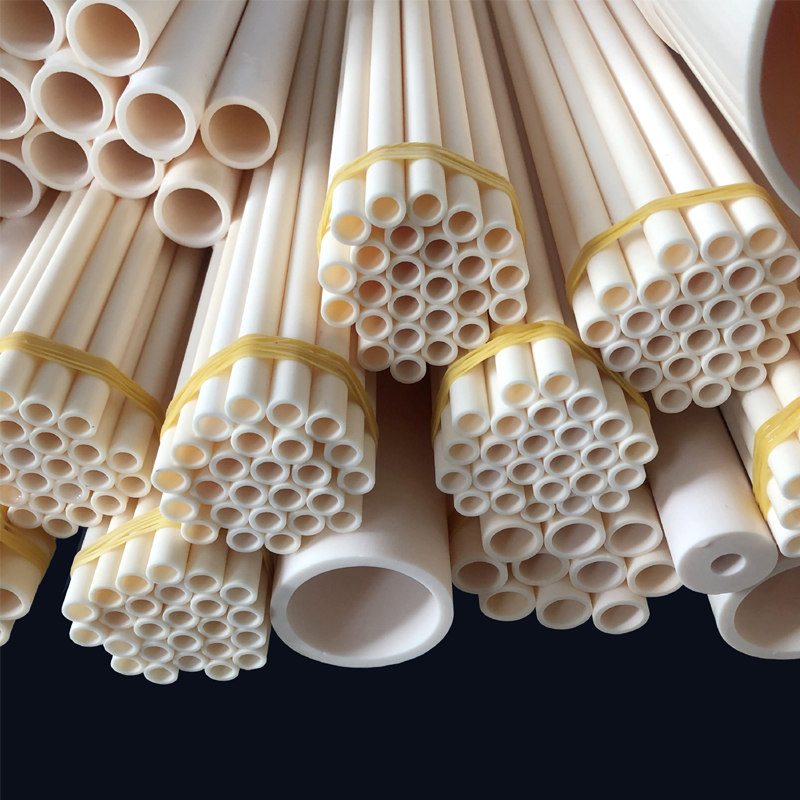
Authoritative testing data indicates that alumina ceramics possess outstanding mechanical strength advantages. According to the testing standards of the Beijing Zhongke Guangxi Science and Technology Research Institute, alumina ceramics compliant with ISO 6474 specifications exhibit a flexural strength of ≥300MPa, fracture toughness KIC value of ≥3.5MPa·m¹/², elastic modulus of ≥300GPa, and compressive strength with a minimum load limit of 50kN. Notably, the strength of alumina ceramics is closely related to their purity. Technical documentation from IPS Ceramics shows that alumina ceramics with 92%, 95%, and 99% purity achieve bending strengths of 150MPa, 175MPa, and 200MPa respectively. Higher purity also enhances high-temperature stability, with products of 99% purity capable of withstanding temperatures up to 1600°C.
The current GB/T 6569-2021 "Test Method for Bending Strength of Fine Ceramics" in China strictly regulates the strength testing of alumina ceramics. The three-point or four point bending test method is used to ensure the accuracy of strength data by accurately controlling the loading speed and span size in a standard environment of 23 ℃± 2 ℃ and relative humidity of 50% ± 5%. The test results show that the Vickers hardness of high-quality alumina ceramics is ≥ 1500, far exceeding that of ordinary metal materials. Its high-strength characteristics are derived from the dense structure formed by high-temperature sintering, and the open porosity can be controlled below 0.5%, effectively improving the material's resistance to damage.
The excellent strength performance makes alumina ceramics shine in the high-end field. In aerospace engine systems, 99% pure alumina ceramics are applied to core components such as combustion chambers and turbine blades, which can work stably for a long time at high temperatures of 1700 ℃ without the need for complex cooling designs to withstand high-temperature gas erosion, significantly improving engine efficiency and service life. In thermal protection systems, its low thermal conductivity and high melting point make it a "fireproof suit" for spacecraft re-entry into the atmosphere. After special coating treatment, its 1400 ℃ flame ablation performance is six times that of traditional materials. In addition, in the field of electronic devices, high-purity alumina ceramic substrates, with their advantages of high strength and low dielectric loss, have reduced the volume of satellite RF devices by 30% and increased signal transmission efficiency by 20%.
Industry experts say that the strength performance of alumina ceramics has been certified by standard systems and verified through practical applications, and continuous technological innovation is constantly expanding its performance boundaries. In the future, with the large-scale application of toughening technology and the reduction of production costs, alumina ceramics are expected to replace metal materials in more high-end manufacturing fields and become one of the key materials to promote industrial upgrading.