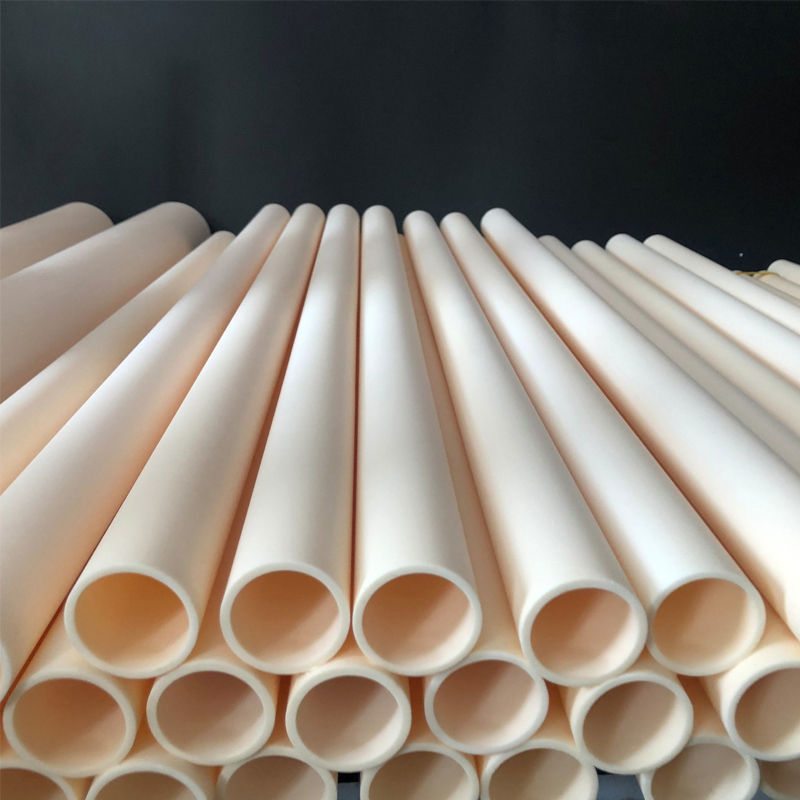
As a special ceramic product made from high-purity alumina as the core raw material through precision forming and high-temperature sintering, alumina ceramic tubes boast outstanding performance advantages.
With a Mohs hardness of up to grade 9, second only to diamond, they feature 5 to 10 times the wear resistance of ordinary steel pipes. In scenarios involving high-speed and high-concentration material erosion, such as mine tailings transportation and power plant pulverized coal conveying, they effectively prevent pipe wall abrasion, leakage and other failures. The service life of pipelines is extended from 1-2 years for traditional steel pipes to 5-15 years, greatly cutting equipment maintenance costs.
Meanwhile, its melting point reaches 2050℃, enabling long-term stable operation in high-temperature environments up to 1600℃. Combined with excellent chemical stability, it resists corrosion from strong acids, strong alkalis and organic solvents, making it perfectly suitable for harsh working conditions in the iron and steel, chemical, petroleum and other industries.
In addition, high-purity alumina ceramic tubes deliver superior insulation performance with a resistivity as high as 1014Ω⋅cm, serving as ideal insulating components for high-end fields including semiconductors and electronic equipment.
Application scenarios keep expanding to meet the upgrading needs of multiple industries. With the continuous advancement of industrial technologies, the application scope of alumina ceramic tubes is steadily broadening, with accelerated penetration from traditional industrial sectors to emerging fields such as high-end manufacturing and new energy.
In the mining and metallurgy industry, they are widely adopted in tailings and concentrate transportation as well as blast furnace coal injection pipelines. Capable of withstanding high temperature, high pressure and scouring by high-concentration dust, they ensure uninterrupted production. In the power industry, their outstanding wear and corrosion resistance effectively resolve the wear and tear issues of coal powder conveying and desulfurization pipelines, helping improve power generation efficiency. In the chemical industry, they serve as a cost-effective alternative to expensive alloy steels for conveying corrosive media including hydrofluoric acid and concentrated sulfuric acid, greatly cutting down enterprises’ production costs.
Notably, in the semiconductor sector, high-purity alumina ceramic tubes with a purity of ≥99.5% are extensively used as diffusion furnace tubes and insulating sleeves for ion implanters, priced at 800,000 to 1.5 million RMB per ton, acting as the "invisible guardian" of chip manufacturing. Driven by the development of solid-state batteries and the hydrogen energy industry, the market demand for ZrO₂ gradient-doped corrosion-resistant tubes and similar products has surged in the new energy field. The consumption volume related to lithium batteries increased by 34.6% year-on-year in 2025, and their zero-pollution performance also guarantees the purity of cathode materials.