Iteration of Mainstream Molding Processes: Adapting to Diverse Scenarios, Balancing Efficiency and Quality
As a core step in the preparation of alumina ceramics, the molding process directly determines the product’s density, uniformity and final performance.At present, the mainstream molding technologies in the industry are continuously optimized and upgraded, forming mature solutions suitable for different application scenarios.
Dry Pressing Molding: Continuous Improvement in Mass Production Efficiency
As a traditional and the most widely used molding process, dry pressing molding compacts alumina powder into shape via hydraulic or mechanical pressure (100-200 MPa). It is suitable for products with simple shapes and an aspect ratio ≤ 4:1, such as ceramic liners, insulators, standard gaskets, etc.
Isostatic Pressing: Breaking Bottlenecks for Complex Structures and Large‑size Components
In response to the demand for complex shapes, large‑size components and high uniformity that cannot be met by dry pressing, isostatic pressing has achieved key technological breakthroughs.
Cold Isostatic Pressing (CIP) applies uniform pressure in all directions via liquid or gaseous media to densify alumina powder placed in elastic molds. The pressure can reach 200–300 MPa, and the green density can reach 62–65% of the theoretical density.
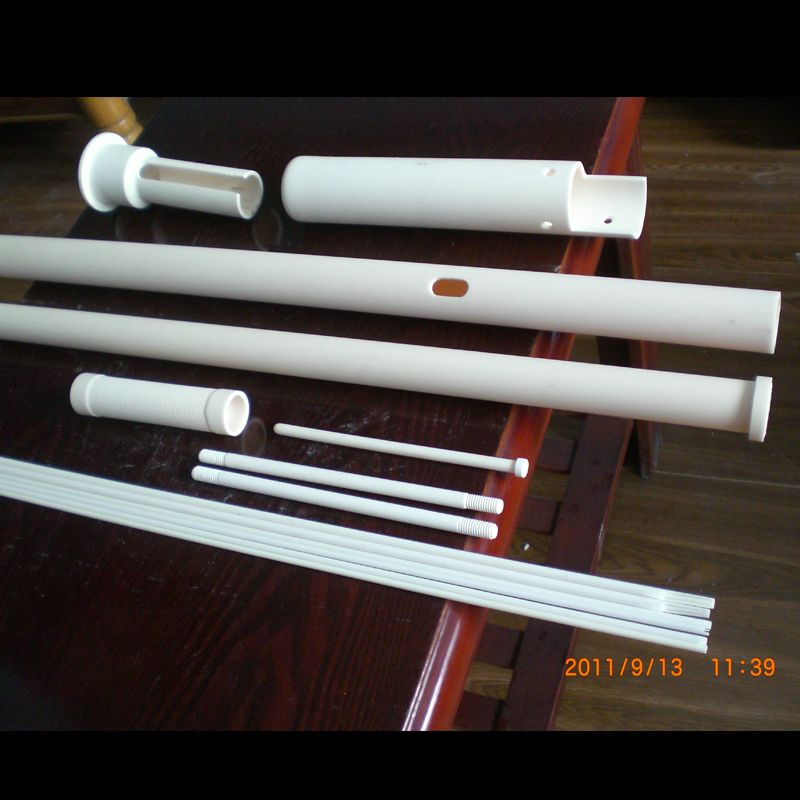
Compared with uniaxial pressing, it effectively eliminates the density gradient effect, reduces the risk of deformation and cracking, and can produce complex structures such as ceramic tubes and special-shaped parts with almost no obvious size limitation.
Ceramic Injection Molding and Gel Casting: Achieving Near-Net Shape for Complex Precision Components
In response to the differentiated demands for micro complex parts and large-size special-shaped components, Ceramic Injection Molding (CIM) and gel casting technologies exhibit unique advantages.
Gel casting solidifies the ceramic slurry through in-situ polymerization. The resulting green body features high strength and allows machining such as turning, milling and drilling, realizing near-net shaping of large-size, complex thin-wall parts.
This process ensures excellent uniformity of the green body and high design freedom. It has been successfully applied in high-end equipment including semiconductor components and wave-transparent radomes, solving the difficult problem of forming complex structures that traditional processes can hardly achieve.
Process Integration and Innovation: Breaking Limitations of Single Processes, Ushering in a New Era of Customization
At present, the core breakthrough in alumina ceramic forming technology lies in process integration and precise parameter control. The industry is gradually breaking through the limitations of single processes, maximizing performance through multi-technology collaboration.