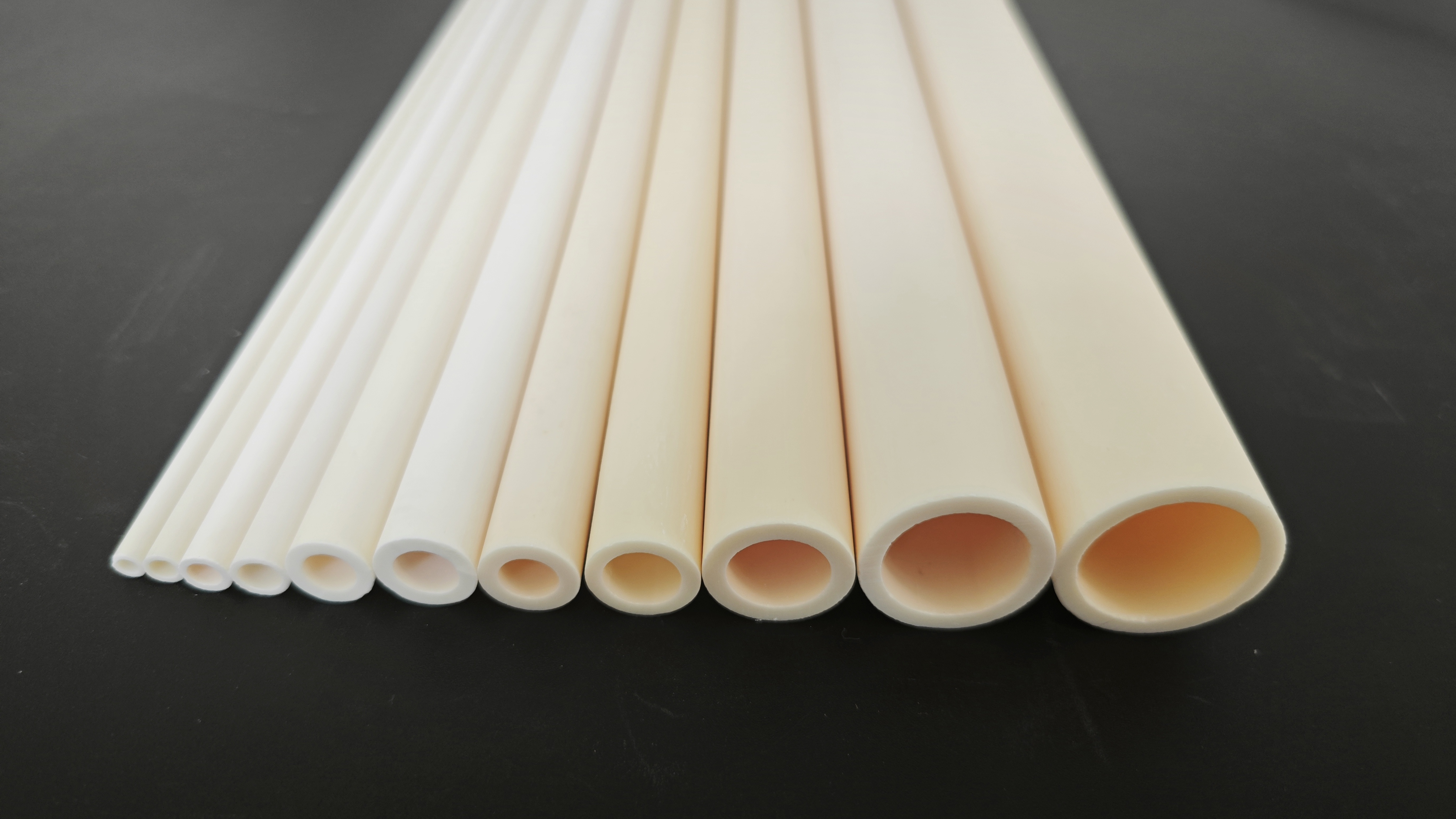
As the core hub for scientific research innovation and talent cultivation in universities, the performance of laboratory consumables directly impacts the accuracy of experimental results, the safety of experimental processes, and the depth of scientific research exploration. Compared with the alumina ceramic tubes commonly used in the industrial sector, the special-purpose products for university laboratories are developed based on the particularities of scientific research experiments. They have achieved targeted breakthroughs in material formulation, structural design and process optimization, and highlighted the core advantages of high precision, high cleanliness, high compatibility and easy operation.
In terms of material purity and performance control, this special alumina ceramic tube is manufactured from high-purity alumina powder with a purity of ≥99.3% via the processes of dry pressing, high-temperature sintering at ≥1700℃, and precision grinding and polishing, which eliminates the contamination of experimental samples caused by impurity precipitation from the source. It boasts outstanding core performance: it can operate stably for a long time in a high-temperature environment of 1600℃ and withstand a short-term temperature of up to 1800℃, far exceeding the temperature requirements of conventional high-temperature laboratory tests (800-1200℃). Meanwhile, it features excellent thermal stability, which can effectively avoid the risk of thermal shock cracking during rapid heating and cooling, thus ensuring the continuity of long-term experiments. In addition, the ceramic tube has a high resistivity of up to 10¹⁴Ω·cm and a dielectric strength of 25KV/mm, delivering superior insulating performance and making it suitable for high-voltage experimental scenarios. It also exhibits extreme inertness to strong acids, strong alkalis, molten metals and other substances without any chemical reaction, enabling wide application in harsh scenarios such as corrosive reagent treatment and high-temperature melting experiments. This product solves the experimental interference problems caused by the easy corrosion of traditional metal tubes and insufficient purity of ordinary ceramic tubes.
In response to the characteristics of school laboratories, such as a diverse range of experiment types and a complex variety of instrument specifications, this special alumina ceramic tube is designed for full-scenario adaptation. The product is available in multiple forms including double-open ends, bottom-sealed type, thin-walled high-precision capillary tubes, and large-caliber thick-walled protection tubes. Its inner diameter, outer diameter and length can be customized according to the specifications of different laboratory instruments such as tube furnaces, high-temperature furnaces and reaction kettles, covering various scientific research scenarios including university basic chemistry laboratories, material synthesis laboratories and metallurgical powder testing laboratories.
Meanwhile, its surface is precision ground and polished with a smooth, burr-free inner wall, which reduces sample residue and adsorption and ensures the repeatability of experimental data. The tube features high density with a true density of up to 3.9g/cm³ and a porosity of less than 0.1%, which can meet the requirements of special working conditions such as vacuum experiments and gas delivery, and is suitable for cutting-edge experimental projects including material synthesis, chemical vapor deposition (CVD) and vacuum sintering.
In terms of experimental safety and user-friendly design, this product fully takes into account the dual characteristics of teaching and scientific research in university laboratories. It optimizes the wall thickness and mechanical properties of the tubing, with a flexural strength of up to 300-400MPa and a compressive strength as high as 2000-3000MPa. Balancing structural stability and operational convenience, it not only prevents breakage caused by collision during experiments but also facilitates the loading, removal and cleaning by laboratory personnel. Meanwhile, the product is manufactured in strict compliance with the ISO9001 quality management system. Each batch of products has undergone multiple tests including high temperature resistance, corrosion resistance and dimensional accuracy, ensuring the consistency of product performance and providing a reliable guarantee for the standardization of experimental teaching and the rigor of scientific research experiments.
According to the person in charge of R&D, the R&D and application of alumina ceramic tubes dedicated to university laboratories focus on the core pain points of scientific research experiments, integrate advanced ceramic material preparation technologies with the demand of laboratory scenarios, and fill the market gap in the segmented field of dedicated laboratory ceramic consumables. At present, this product has been successfully applied in professional laboratories of materials science, chemical engineering, environmental science and other disciplines in many universities, and has delivered outstanding performance in projects such as high-temperature oxidation experiments, new material synthesis and precision sample detection. It not only effectively improves experimental efficiency and reduces the consumption and maintenance costs of experimental consumables, but also helps researchers obtain more accurate and reproducible experimental data, providing strong support for the advancement of cutting-edge scientific research projects.
Industry experts state that the large-scale application of special alumina ceramic tubes embodies the in-depth integration of advanced material technologies with the demands of scientific research and experiments. As the scientific research capacity of universities continues to advance, the requirements for professionalization and refinement of laboratory consumables will keep rising. The R&D and promotion of such customized, high-performance laboratory consumables will further improve the supporting system for scientific research and experiments, drive the high-quality development of related disciplines such as materials science, chemistry and chemical engineering, and inject new impetus into scientific research innovation and talent cultivation.