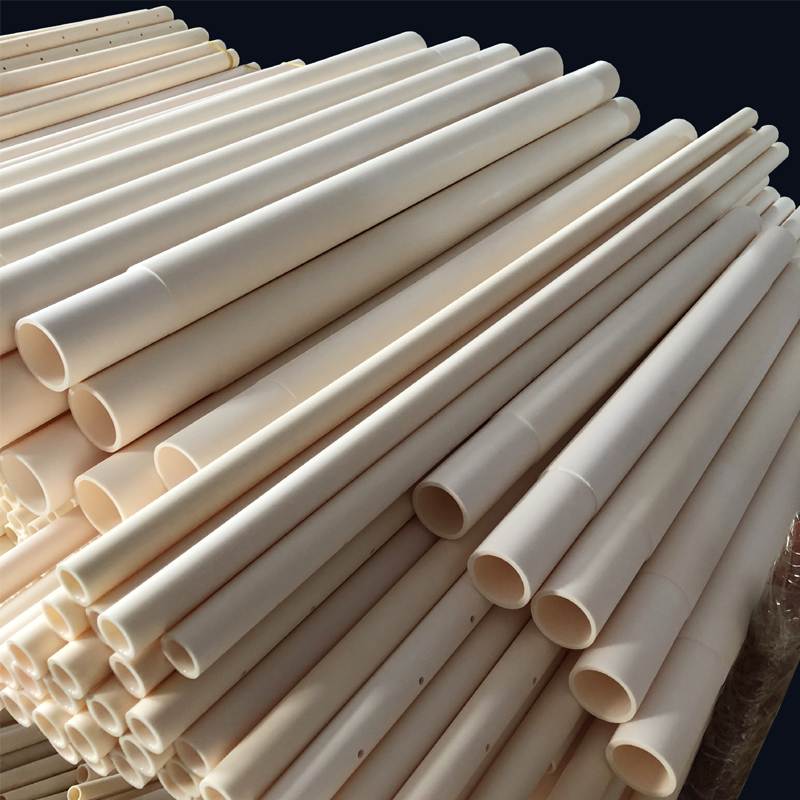
Alumina ceramic tubes, with their unique advantages such as high temperature resistance, strong insulation and high cleanliness, have become an indispensable core supporting component in semiconductor production lines. They silently underpin the breakthrough of chip manufacturing processes to the 7nm, 5nm and even more advanced nodes, forging a deeply interactive pattern where materials propel the industry and the industry drives material upgrading.
Semiconductor manufacturing is hailed as "a dance on the tip of a needle", imposing nearly stringent standards on the performance of production environments and equipment components — it requires withstanding high-temperature processes of over 1,000 degrees Celsius, resisting corrosion from strong acids and alkalis, eliminating any impurity contamination, and ensuring micron-level dimensional accuracy. Traditional metal or plastic components are prone to deformation, corrosion or impurity release under such extreme working conditions, making it difficult for them to meet the core requirements of semiconductor manufacturing. However, the inherent properties of alumina ceramic tubes precisely meet this series of demands, making them a key material to solve the pain points of the industry.
As semiconductor technology advances toward higher-end and more sophisticated manufacturing, the application scenarios of alumina ceramic tubes are continuously expanding, and the linkage between the two is becoming increasingly close. In thin film deposition equipment, they serve as liner tubes inside reaction chambers, isolating high temperatures and corrosive gases while protecting the main chamber structure; in ion implanters, they are a key component of ion beam transmission channels, ensuring the stable transport of ion beams; in vacuum sintering furnaces, they act as insulating separation tubes and gas delivery tubes, adapting to ultra-high cleanliness working conditions. At present, leading domestic and international chip manufacturers such as TSMC and SMIC widely adopt high-purity alumina ceramic tubes in their production lines. Among these, ultra-high-purity products with a purity of over 99.7% have become indispensable supporting components for the manufacturing of advanced process chips at 7nm and below, thanks to their extremely low impurity content and high density.
Industry data shows that the global alumina ceramic market scale has exceeded billions of US dollars and is growing steadily at an annual rate of over 5%. Among this, the demand for high-purity alumina ceramics accounts for more than 40% of the total, with the semiconductor industry being one of its core demand sectors. With the rapid development of China's semiconductor industry, the demand for high-end alumina ceramic tubes has been rising year by year, driving domestic alumina ceramic enterprises to increase R&D investment and achieve continuous breakthroughs in aspects such as material purity and dimensional accuracy.