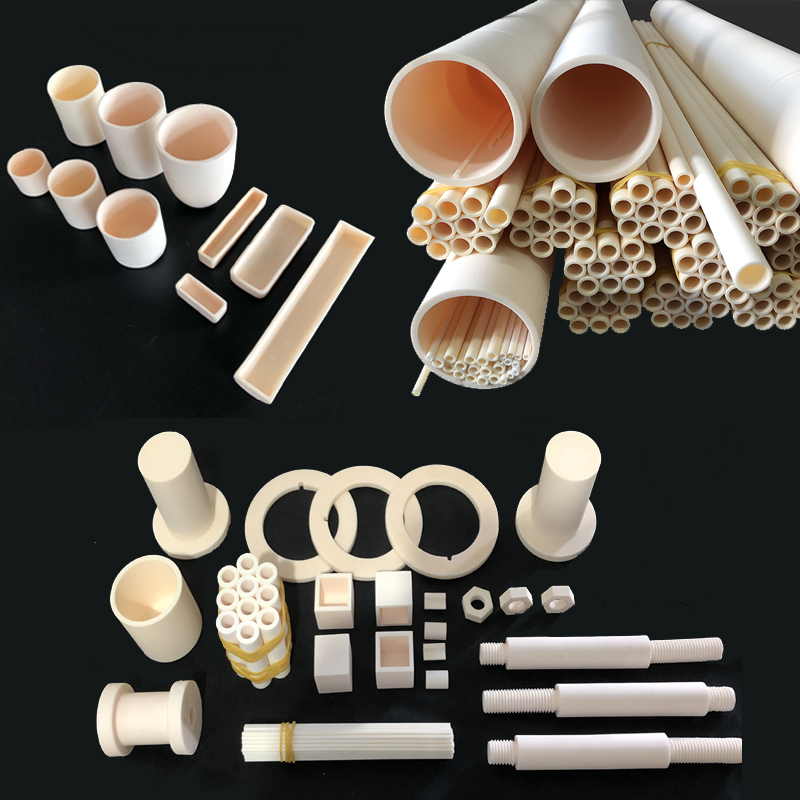
Alumina ceramic is a new type of inorganic non-metallic material with alumina as its main crystalline phase. Boasting well-balanced and superior overall properties, it ranks among the most widely applied and cost-effective advanced ceramics available today. It features remarkable core competitive advantages over conventional metals, plastics and other ceramic materials.
Outstanding wear resistance and superior mechanical properties are the core advantages of alumina ceramics. Boasting a Mohs hardness of Grade 9, second only to diamond, this material far outperforms all types of industrial metals in hardness, with its HRA hardness ranging from 85 to 90. In terms of abrasion resistance, it is 10 to 20 times more wear-resistant than ordinary carbon steel, 171.5 times that of high-chromium cast iron and 266 times that of manganese steel, delivering prominent performance merits under abrasive working conditions in mining, building materials, chemical and other industries.
Thanks to its outstanding ultra-high temperature resistance and superior thermal stability, alumina ceramic holds a pivotal position in high-temperature industrial applications. Boasting a melting point of 2050°C, it can operate steadily at a constant high temperature of 1600°C over long-term service without softening, deforming or oxidizing under heat. It also features a low coefficient of thermal expansion and excellent thermal shock resistance.
Its outstanding chemical stability and corrosion resistance enable its application in complex chemical and biological environments. As an inert inorganic material, alumina ceramic features exceptional resistance to most chemical media including acids, alkalis, organic solvents and corrosive gases. It resists corrosion, ageing and deterioration, and generates no chemical reactions with contacting media to cause contamination.
Featuring superior electrical insulation properties, it underpins the development of the electronics and semiconductor industry. It delivers ultra-low dielectric loss under high-frequency operating conditions alongside stable and outstanding insulation performance, with inherent advantages of high-temperature resistance, high-voltage endurance and breakdown resistance.
In addition, compared with high-end advanced ceramics such as silicon carbide and silicon nitride, alumina ceramics feature mature preparation processes and controllable mass-production costs, delivering outstanding cost performance. Meanwhile, they have extra merits including dense texture, excellent air tightness, ageing resistance and lightweight properties. Balancing high performance and practicality, they are suitable for large-scale industrial production and widespread application.