

Modern spectroscopy systems are increasingly adopting alumina-based ceramic structures, as instrument designers seek greater thermal stability, superior chemical resistance, and more reliable long-term calibration performance. This shift reflects a broader trend in optical engineering: materials with high stability are becoming essential in applications requiring precise geometries to be maintained under high temperatures, vibration, and intense light conditions.
Today’s spectrometers are undergoing a quiet but significant transformation. Engineers in research laboratories and industrial facilities are gradually moving away from traditional metal hardware in favor of components based on high‑purity alumina ceramics. This shift is not driven by a single breakthrough, but rather by a growing recognition that metal parts can introduce small yet cumulative stability issues—especially in systems requiring highly precise optical measurements.
Many long-standing issues that have plagued spectroscopy stem from the material properties of metal components. Even relatively stable metal alloys experience thermal expansion under temperature changes, which is sufficient to alter the optical path or cause wavelength drift. For instruments that rely on stable baseline readings or repeatable calibration cycles, these effects can limit reproducibility. Corrosion is also a challenge—especially in instruments exposed to moisture, solvents, or reactive chemical vapors—where even slight oxidation can create surface irregularities that affect alignment or signal transmission.
These recurring mechanical and chemical issues have prompted designers to re-evaluate the materials used to secure optical components. Alumina ceramics, made from high-purity alumina, have come into focus because they maintain structural stability even when exposed to high-intensity light or high-temperature environments. Their crystal structure is inherently resistant to deformation, and their coefficient of thermal expansion is significantly lower than that of the steel, aluminum, or magnesium enclosures commonly used in older spectrometer designs.
This stability is one of the primary reasons why laboratories and manufacturers are evaluating alumina ceramic components as an alternative to traditional mechanical parts. Even when subjected to rapid heating from lasers or halogen lamps, this material maintains tight dimensional tolerances. Unlike metals, alumina does not soften or deform with temperature changes, nor does it chemically react with typical laboratory solvents or corrosive vapors used in spectroscopy workflows.
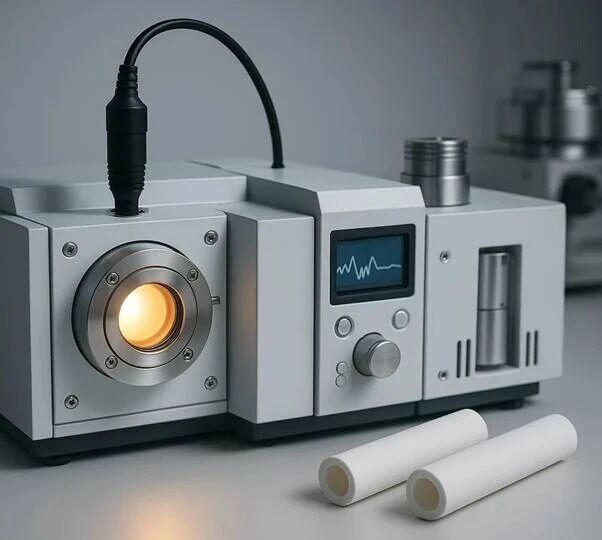
In spectrometers and related analytical instruments, alumina ceramics are now being used in numerous non-optical yet critical positions. These include structural supports located near light sources, insulating spacers that block heat transfer between modules, ferrules for isolating optical fibers, and enclosures for housing small detectors or reference elements. In certain Raman systems, alumina structures are placed near the laser excitation point, where thermal gradients are steepest and metal components are prone to expansion or deformation.
High‑purity alumina also offers optical advantages not found in metals. Thanks to its electrical insulation, components made from it do not generate stray currents or electromagnetic noise—factors that can interfere with sensitive photodetectors in certain instrument configurations. Its chemical inertness also prevents surface contamination, which would otherwise cause scattering or background signal artifacts in fluorescence, Raman, or absorption measurements.
Therefore, modern instruments are increasingly adopting high‑purity alumina components in areas requiring optical isolation, chemical stability, or thermal resistance. This trend is not limited to high‑end research systems; mid‑range laboratory instruments and compact industrial analyzers are also integrating ceramic structures to ensure consistent performance over long operating cycles.
While metals will continue to play an important role in other parts of the instrument, the gradual replacement of some metal components with alumina ceramics reflects a shift in engineering priorities. Stability, durability, and long-term measurement reliability have surpassed the traditional reliance on convenience or manufacturing familiarity. As spectroscopy technology continues to evolve, materials such as high-purity alumina will support the development of instruments that maintain reliable performance in increasingly demanding environments.
Note: This article is translated from technology.org and is provided for reference only. The copyright belongs to the relevant media and authors.