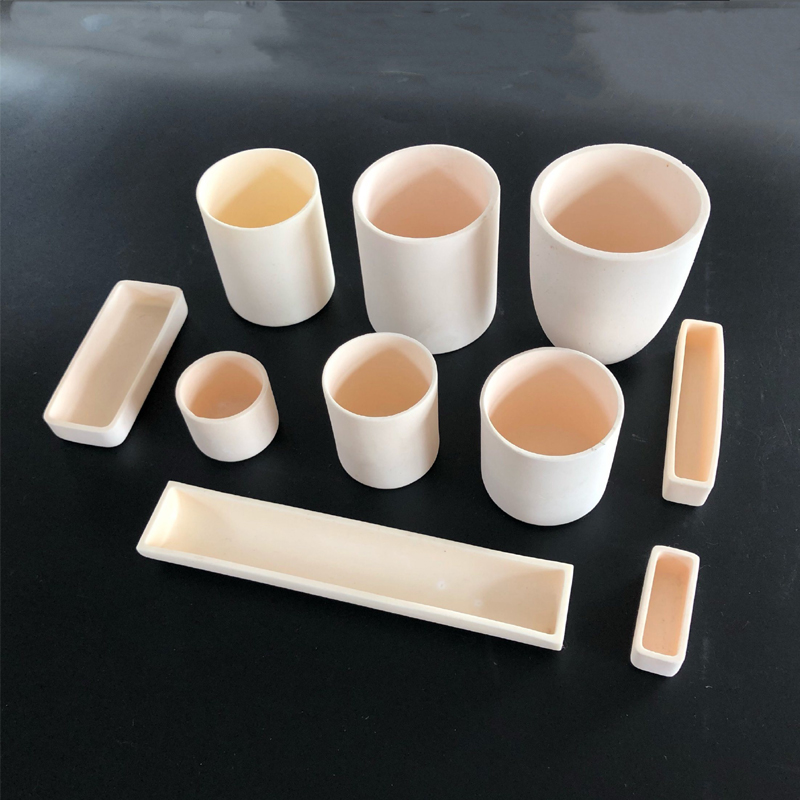
99% purity alumina ceramic crucibles for general industrial scenarios deliver balanced overall performance. They sustain a stable long-term continuous operating temperature of 1500–1600°C and can withstand short-term high temperatures up to 1700°C, featuring outstanding cost performance. These crucibles are widely used in processes including general powder calcination, refractory material testing, and conventional metal melting.
In contrast, low-purity alumina ceramic crucibles with an alumina content of 85% exhibit relatively limited temperature resistance. Their maximum long-term service temperature does not exceed 1200°C, with a short-term peak temperature of approximately 1400°C. They are only suitable for basic laboratory applications under low-temperature and low-load conditions.
Compared with similar products such as quartz crucibles, ordinary ceramic crucibles and silicon carbide crucibles, alumina ceramic crucibles boast an outstanding advantage in high-temperature resistance. Standard quartz crucibles have a maximum service temperature of only 1100℃ to 1200℃ and tend to soften and deform under high temperatures. Silicon carbide crucibles generally cannot withstand temperatures above 1400℃, making them unsuitable for high-end high-temperature processes.
In contrast, alumina ceramic crucibles feature a superior temperature resistance rating, coupled with a low coefficient of thermal expansion, excellent thermal stability and outstanding thermal shock resistance. They can withstand rapid temperature fluctuations and resist cracking caused by sudden heating or cooling. Furthermore, at temperatures above 1700℃, they do not chemically react with media including air, water vapor, hydrogen and carbon monoxide, delivering exceptional chemical inertness.
Thanks to its temperature resistance performance, alumina ceramic crucibles are finding an ever-expanding range of application scenarios.
In scientific research, they are widely adopted by universities and research institutes for material analysis, element ashing and high-temperature phase transformation experiments.
In industrial sectors, they are suitable for induction melting of special alloys, sintering of precision ceramics and high-temperature calcination in powder metallurgy.
In emerging industries, they serve as core high-temperature resistant consumables for semiconductor material manufacturing and new energy powder processing, effectively ensuring cleanliness and process precision during the production of high-end materials.