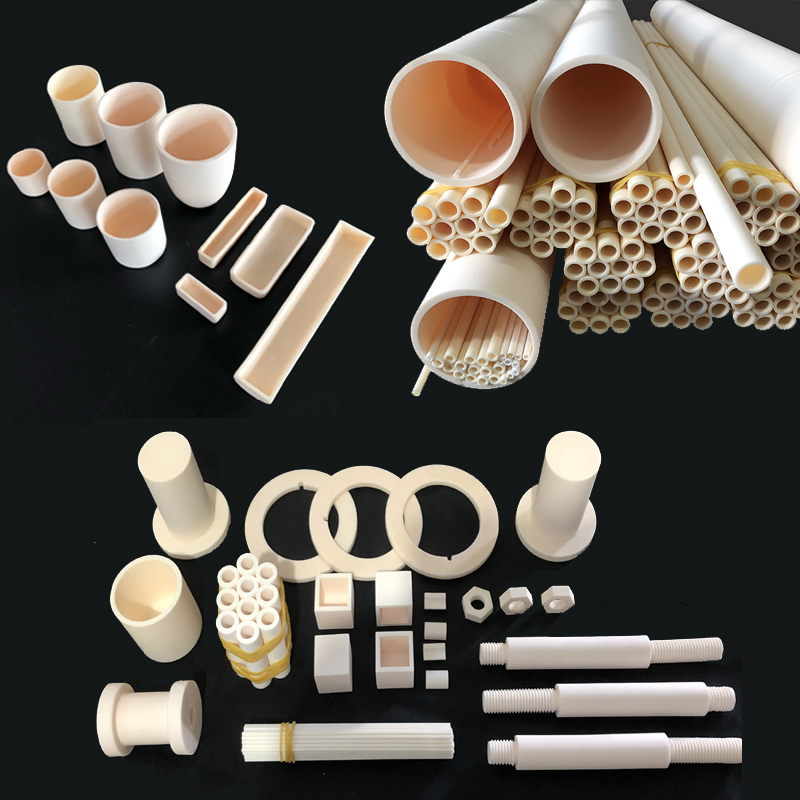
At present, a clear classification system has been established for alumina ceramics. Products of different types are precisely matched to various application scenarios based on differences in purity, performance and forming processes. With technological iteration and cost optimization, alumina ceramics are accelerating their transition from laboratories to industrialization and popularization.
High-purity alumina ceramics have an alumina content ranging from 90% to 99%, with 99 alumina ceramic and 95 alumina ceramic as common grades. They feature high strength, high hardness, excellent wear resistance and corrosion resistance, and are widely used in core industrial applications such as precision mechanical parts, high-temperature furnace components, electronic insulators, and medical devices. Among them, 99 alumina ceramic can be used to manufacture high-temperature crucibles and ceramic bearings, while 95 alumina ceramic is mostly applied in corrosion-resistant and wear-resistant components.
In addition to classification by purity, alumina ceramics can be divided into wear-resistant, high-temperature resistant, insulating, transparent and other specialized types according to their performance and functions.
Wear-resistant alumina ceramics achieve enhanced wear resistance by increasing alumina content and refining grain size. They are often compounded with resins and metals to form wear-resistant liners, which are used for pipeline linings and crusher parts in mining, metallurgy and power industries.
High-temperature resistant alumina ceramics are mostly high-purity grades, some with zirconia added to improve toughness. They maintain structural stability at elevated temperatures and are applied in high-temperature furnace tubes, rocket engine nozzles and other components.
Insulating alumina ceramics feature strict control over conductive impurities and high insulation resistance, serving as core materials for integrated circuit substrates and high-frequency ceramic capacitors in the electronics industry.
Transparent alumina ceramics, relying on their ultra-high purity, are used in high-pressure sodium lamps, halogen tungsten lamp tubes and infrared detection windows.
Notably, zirconia-toughened alumina (ZTA), as a specially modified grade, effectively improves toughness through zirconia addition and is widely used in various industrial scenarios. Its overall performance is superior to that of conventional alumina ceramics.
Classified by forming process, alumina ceramics cater to the product requirements of different shapes and precision levels, mainly including dry pressing, isostatic pressing, slip casting, extrusion molding and other processes.
Dry pressing is suitable for mass production of simple-shaped products such as gaskets and wafers.
Isostatic pressing can manufacture large-scale pipe fittings and special-shaped parts with excellent density uniformity.
Slip casting is applicable to thin-walled and complex-shaped products such as crucibles and special-shaped grooves.
Extrusion molding is mainly used to produce bars, tubes, honeycomb filter tubes and other products.
The optimization and upgrading of different forming processes have further expanded the application boundaries of alumina ceramics.