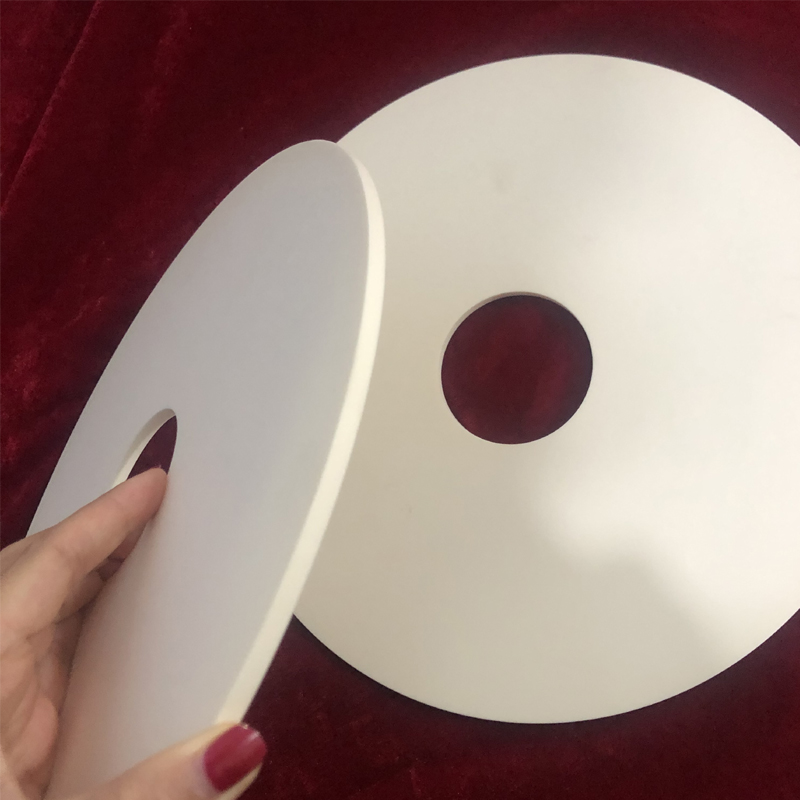
Alumina ceramic round plates are oxide ceramic products made mainly from synthetic alumina or natural bauxite, fabricated through precision forming and high-temperature sintering. They are usually white or ivory yellow in color, which mainly depends on sintering additives and impurity content.
As a high-performance industrial ceramic component, it features core advantages including high hardness, high temperature resistance, corrosion resistance and excellent electrical insulation. It reaches Grade 9 on the Mohs hardness scale, second only to diamond. Its maximum long-term service temperature can hit 1800℃. With extremely low dielectric loss and outstanding mechanical properties, it maintains structural stability and reliable performance under extreme working conditions, making it an indispensable core part in the field of high-end equipment.
In recent years, domestic enterprises and scientific research institutions have worked collaboratively to target the technical bottlenecks of alumina ceramic round plates, achieving multiple breakthroughs in raw material purification, forming processes, precision machining and other fields.
On the raw material side, the preparation technology of high-purity alumina powder has been successfully mastered, enabling the stable production of high-purity products with a purity of over 99%. Meanwhile, toughening modification is realized by adding materials such as zirconia, which effectively solves the major drawback of high brittleness of traditional alumina ceramics and greatly improves the toughness and service life of the products.
In terms of forming and sintering processes, advanced technologies such as spontaneous solidification forming and hot-press sintering are adopted, overcoming the problem of easy deformation and cracking of large-sized products, and meeting the stringent requirements of high-end equipment for precision components.
Technological upgrading drives the continuous expansion of application scenarios, and alumina ceramic round plates have been deeply applied in multiple key fields.
In the new energy sector, they are widely used in the electric drive systems of new energy vehicles, lithium battery production equipment, and photovoltaic thin-film deposition equipment. They can extend the replacement cycle of components in lithium battery workshops from 3 months to 26 months and raise the yield rate of photovoltaic modules from 88% to 97%, helping the new energy industry reduce costs and improve efficiency.
In the semiconductor industry, high-purity alumina ceramic round plates serve as the base material for core components such as etcher chambers and electrostatic chucks. With a purity of over 99.8% and a flexural strength exceeding 350 MPa, they can effectively resist erosion by high-density plasma, provide reliable support for 12-inch wafer manufacturing, and advance the localization of core components for semiconductor equipment.
In chemical engineering, medical treatment and other fields, their excellent properties including corrosion resistance and biological inertness enable their extensive application in corrosion-resistant parts, medical prostheses and other products, further expanding the application boundaries of high-end ceramics.