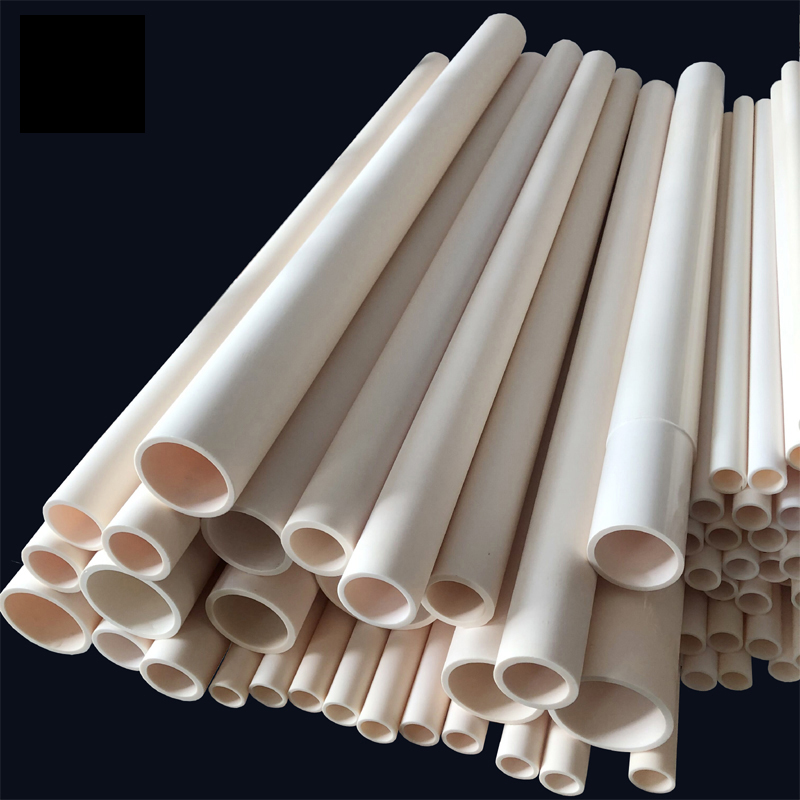
Choosing high toughness alumina ceramics involves considering several key factors to ensure they meet your specific needs. Here is a comprehensive guide to help you make the right choice:
1. Toughness Rating:
Alumina ceramics with high toughness ratings are preferred for applications where resistance to cracking or breaking is essential. Look for ceramics with a high fracture toughness value, typically expressed in MPa·m^0.5.High toughness is a key characteristic that distinguishes alumina ceramics from ordinary ceramics, and its performance improvement comes from different toughening technology paths. The primary task of selection is to clarify technical adaptability. Traditional toughening methods mainly include zirconia phase transformation toughening, whisker/fiber toughening, etc., but there is a common contradiction between strength and toughness. For example, the fracture toughness of conventional 95% alumina ceramics is only 3.9-4.0 MPa · m ¹/², while 99% alumina ceramics, although increased to 5.0 MPa · m ¹/², still cannot meet the requirements of extreme working conditions.
2.Focus on key performance indicators and verify compliance with testing standards
Performance indicators are the core basis for judging the quality of high toughness alumina ceramics. When purchasing, it is necessary to focus on verifying key parameters and confirming that the product meets relevant standards. The testing experts from Beijing Zhongke Institute of Optics and Fine Mechanics have provided a reference range for core indicators: fracture toughness KIC value should be ≥ 3.5MPa · m ¹/² (high-end products can exceed 12MPa · m ¹/²), bending strength ≥ 300MPa, Vickers hardness HV ≥ 1500; In terms of thermal performance, the coefficient of thermal expansion α ≤ 8 × 10 ⁻⁶/K (RT to 1000 ℃), and the number of thermal shock cycles ≥ 100 without cracking; In terms of microstructure, the average grain size is ≤ 5 μ m, porosity is ≤ 1%, and impurity content is ≤ 0.1wt%.
These indicators are not necessarily the higher the better, and need to be balanced between performance and cost based on application scenarios. "Testing experts emphasize that the electronic and electrical field needs to pay extra attention to electrical indicators, such as volume resistivity ≥ 1 × 10 ¹⁴Ω· cm, dielectric loss tan δ ≤ 0.001; The chemical industry should focus on verifying the corrosion resistance performance to ensure that products have no corrosion marks in strong acid and alkali environments; Artificial joints and dental restorative materials in the medical field also require supplementary biocompatibility testing reports. At the same time, all indicators must comply with standards such as ISO 6474:2019 or GB/T 25995-2010, and the manufacturer should be required to provide a third-party testing certificate during procurement.
3.Accurate matching based on application scenarios to avoid selection errors
The demand for high toughness alumina ceramics varies significantly in different industry application scenarios, and precise matching of scenarios is the key to selection. We have sorted out the key selection points in various fields and found that the electronics industry presents a clear stratification: for conventional high-voltage switches, transformers and other equipment, choosing 95% alumina ceramics can balance insulation performance and cost; For high-end scenarios such as semiconductor manufacturing and core components of lithography machines, it is necessary to use 99% high-purity products with a dielectric strength of 25-30MV/m, which can maintain stable insulation in high voltage and high frequency environments.
Common selection misconceptions in the industry include blindly pursuing high purity, resulting in cost waste, neglecting the impact of sintering process on performance, and failing to verify key characteristics such as thermal shock resistance and corrosion resistance based on working conditions. The technical director of Yixing Xiangchao Special Porcelain Industry suggests that a working condition evaluation should be conducted before procurement to clarify core parameters such as temperature, pressure, and medium. If necessary, the manufacturer can be requested to provide samples for trial use.
The core of selection in the mechanical manufacturing industry is the working condition strength: universal components such as yarn guides and ordinary pump valves in textile machinery, and the wear resistance of 95% alumina ceramics can extend their service life by more than 10 times; High end applications such as precision machine tool guides and high-temperature furnace transmission components require the use of 99% alumina ceramics, which have a Rockwell hardness of 80-90HRA and wear resistance equivalent to 266 times that of manganese steel, and can withstand high-frequency friction and impact. The core components of the aerospace and medical industries require ultimate performance guarantees. Rocket nozzles, artificial joints, etc. must use high-purity toughened ceramics with a purity of over 99%. Auxiliary components can be selected with 95% product balance cost according to demand.
4. Select high-quality suppliers to ensure the reliability of products and services
The technical and service capabilities of suppliers directly affect the quality of procurement. Experts suggest screening partners from four dimensions: firstly, technical strength, giving priority to manufacturers with core toughening technology and professional R&D teams, such as those with high-temperature and high-pressure sintering processes and 3D printing customization capabilities; The second is product adaptability. Priority should be given to manufacturers that cover their own application fields and have mature cases. For example, in the textile industry, suppliers that supply well-known textile machinery enterprises can be focused on; The third is the ability to provide customized services. For irregular parts and special performance requirements, it is necessary to confirm whether the manufacturer can deliver samples within 10-15 days based on drawings and samples; The fourth is market reputation. Through industry research, we can understand the quality stability, timely delivery, and after-sales technical support level of manufacturers.
Industry experts have summarized that the selection of high toughness alumina ceramics should follow a closed-loop logic of "technical matching index verification scenario adaptation supplier screening", avoiding "performance only" or "price only". With the continuous breakthroughs in toughening technology, customized and high-performance products will become the mainstream of the market in the future. Enterprises need to strengthen technical collaboration with suppliers in order to maximize material value.