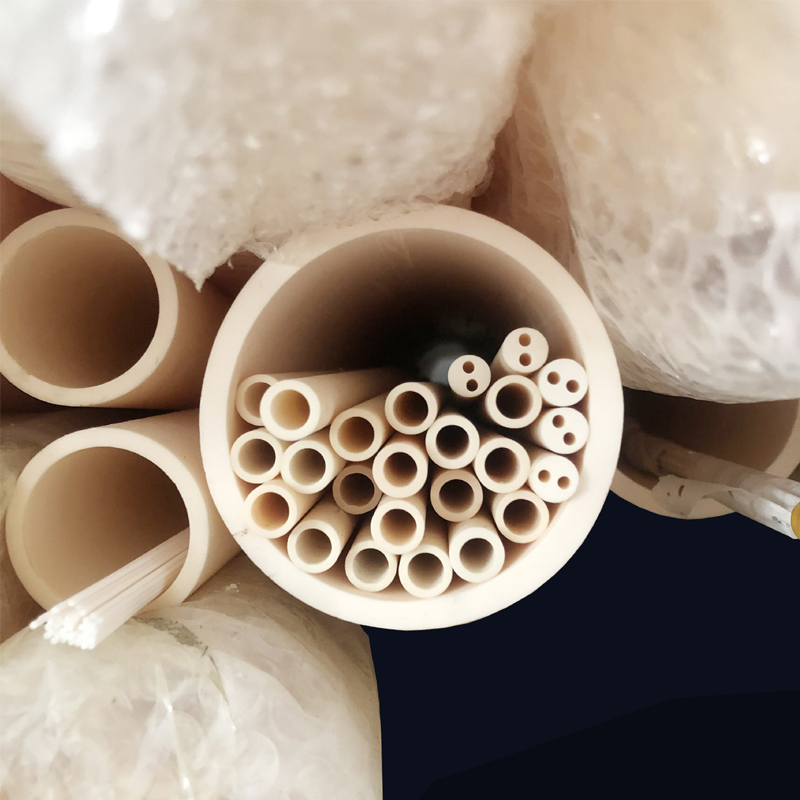
According to market research data, the price of domestic alumina ceramic tubes is clearly stratified, with significant price differences among products of different grades.
Among ordinary industrial-grade products, low-purity (less than 95%) alumina ceramic tubes used for insulation and basic protection start at as low as $0.023 per piece for small-sized basic models.
For 95% purity alumina ceramic tubes in common specifications (e.g., diameter 10–50 mm, length 50–200 mm), prices mainly range from $0.23 to $4.12 per piece.
Wear-resistant and high-temperature-resistant 99% purity corundum ceramic tubes are priced between $0.34 and $41.18 per piece, among which large-diameter and custom-made special-specification products are relatively expensive.
Some non-standard custom corundum tubes for tube furnaces can cost more than $41.18 per unit.
The price differentiation of alumina ceramic tubes is fundamentally determined by four key factors.
First, raw material cost serves as the foundation. The higher the purity of alumina powder, the greater the price difference. Ceramic tubes made from 99.9% pure alumina powder can be several times more expensive than those made from 95% pure material. Meanwhile, price fluctuations of auxiliary raw materials are also passed on to end-product prices.
Second, production processes vary significantly. Ordinary products formed by dry pressing have relatively low costs. In contrast, high-performance products manufactured via processes such as isostatic pressing, hot-press sintering, and 3D printing involve substantial equipment investment and long production cycles, leading to sharply higher costs and correspondingly higher prices.
Third, specifications and customization requirements affect pricing. Smaller diameters, thinner wall thicknesses, and greater lengths increase production difficulty and reject rates, resulting in higher prices. Prices of special-shaped and customized products are more than 30% higher than those of standard models.
Fourth, market supply and demand dominate price fluctuations. In recent years, the accelerated domestic production of semiconductor equipment, the expansion of photovoltaic N-type cells, and the faster construction of perovskite cell pilot lines have driven a surge in demand for high-end alumina ceramic tubes, pushing their prices to rise steadily. By contrast, prices of ordinary industrial-grade products have remained stable due to sufficient production capacity.
Although high-end alumina ceramic tubes are relatively expensive, they offer significant cost-performance advantages over their full life cycle
Accounting data from a thermal power plant shows that the annual maintenance cost of ordinary coal conveying pipelines exceeds 1.2 million yuan. After replacing them with wear-resistant alumina ceramic tubes, the total maintenance cost for three years is less than the cost for one year of the original pipelines, resulting in substantial long-term savings.