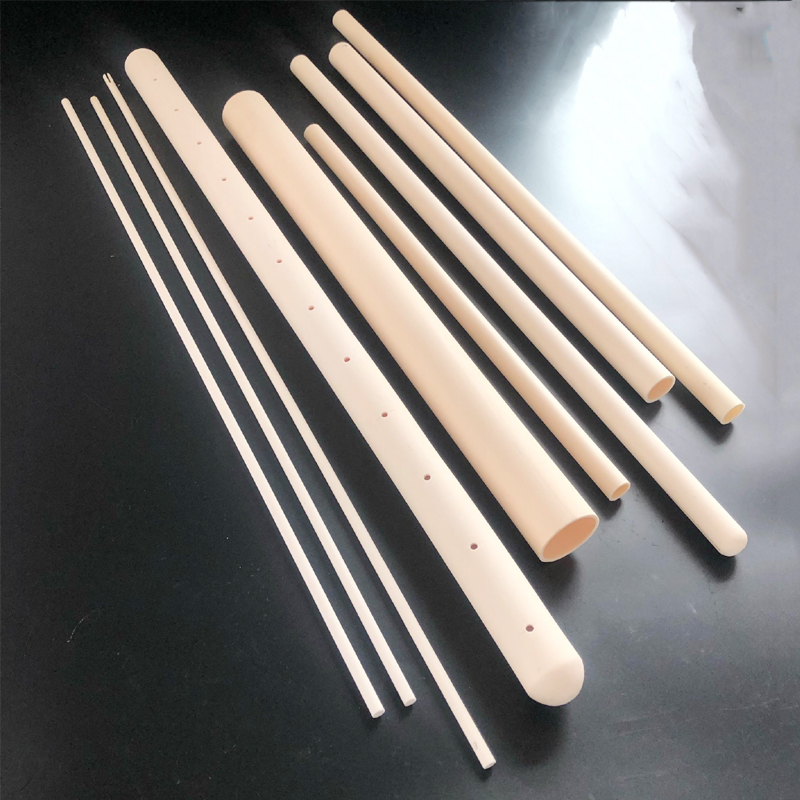
The production and delivery lead time of alumina ceramic tubes is not a fixed value. It mainly depends on the complexity of product design, dimensional specifications and order quantity, and is also affected by production process, raw material purity and other factors. As a result, the conventional delivery lead time in the industry varies.
Alumina ceramic tubes are tubular industrial components manufactured from high-purity alumina as the core raw material through multiple standardized processes, including powder preparation, forming, high-temperature sintering, and precision finishing. With outstanding properties such as high temperature resistance, corrosion resistance, and electrical insulation, they are widely used in various applications including chemical medium transmission, new energy lithium battery production, metallurgical high-temperature flow guidance, and more. Unlike standard mass-produced products, alumina ceramic tubes have an extremely high proportion of customized requirements, and this customization feature is the key factor leading to differences in delivery cycles.
The complexity of product shape directly determines the intricacy of the production process, which in turn affects the delivery lead time. According to industry insiders, conventional straight pipes are simple in structure and can be mass-produced using the extrusion molding process without the need for complex mold development. The production flow is smooth, and the delivery lead time is relatively short.
In contrast, special-shaped products such as elbows, tees, and reducers require individually designed and manufactured dedicated molds. Mold development usually takes 10–15 days, and for some complex special-shaped parts, it may even take more than 20 days. Meanwhile, precise control of process parameters is required during forming and sintering to avoid defects such as cracking and deformation. As a result, the overall delivery lead time is extended by 30%–50% accordingly.
Size specification is another key factor affecting delivery lead time.
For alumina ceramic tubes of conventional sizes (e.g., outer diameter 3–100 mm, length 10–800 mm), rapid production can be achieved using existing production equipment and molds. These products feature high efficiency in sintering and precision finishing, making them the category with the shortest delivery lead time in the industry.
In contrast, the production cycle for large‑size or ultra‑high‑precision products (with dimensional tolerance controlled within ±0.5 mm) will increase significantly. The delivery lead time for some custom large‑size products can reach 45–60 days.
Order quantity is directly related to production batch size, which has a scalable impact on delivery lead time.
Small-batch orders (within 100 pieces) do not require large-scale production scheduling or raw material stocking and can quickly enter the production process, with a typical delivery lead time of 15–25 days.
Medium-batch orders (100–500 pieces) usually have a delivery lead time of 25–40 days.
Large-batch orders (more than 500 pieces) generally have a delivery lead time of 60–90 days. For some extra-large orders, the delivery period may be appropriately extended based on mutual agreement.