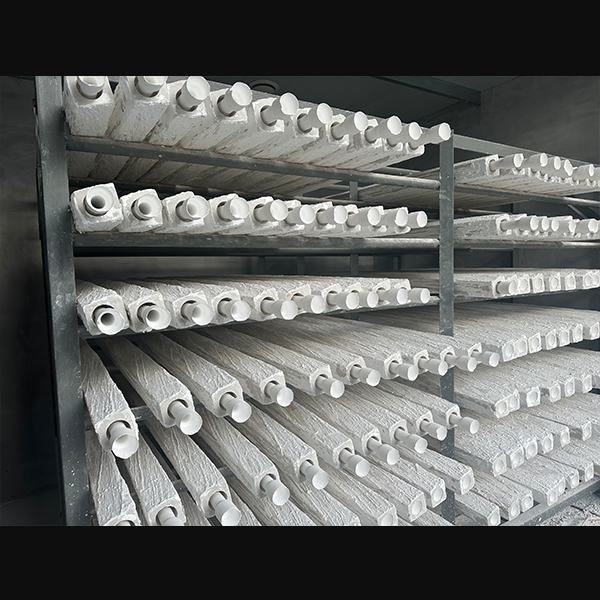
As a core special structural ceramic for industrial applications, alumina ceramic tubes feature superior electrical insulation, exceptional wear resistance, strong chemical inertness and outstanding thermal stability. They are widely applied across full-spectrum scenarios including laboratory tube furnaces, semiconductor diffusion furnaces, transportation of corrosive chemical media, sintering of new energy lithium batteries, and high-frequency electrical insulation in industrial equipment.
1. Ordinary static high-temperature conditions
Under ordinary static high-temperature conditions, the service life of 99% alumina ceramic tubes can reach 30,000 hours. However, under the 2.4 GHz high-frequency alternating electric field in semiconductor applications, slight polarization damage occurs at the grain boundaries on the inner wall of ceramic tubes. Coupled with extreme thermal cycling shocks of over 80 °C per minute, micropores at grain boundaries expand rapidly, cutting the service life by more than 40%.In hydrogen energy operating environments, permeation of trace free hydrogen undermines the stability of the alumina crystal lattice. Compared with conventional oxidizing service conditions, the flexural strength of the tubes drops by 27%. This is the core reason why alumina ceramic tubes specially designed for hydrogen energy equipment cannot be replaced by standard industrial ceramic tubes.
2. Alumina purity
For a long time, the industry has adhered to the established conclusion that the higher the alumina purity, the better the performance of tubular products. However, microscopic material test data indicates that with the same high-purity powder of 99.8% alumina, factors including the distribution of grain boundary phases in powder, the interfacial bonding degree between the inner and outer tube walls, and the micron-scale closed porosity exert a far greater impact on performance than the purity index itself.
3. During sintering
Unlike obvious process defects such as cracking during sintering, residual mechanical stress and thermal stress left after fully automatic isostatic pressing, CNC precision grinding, cutting and chamfering are latent influencing factors that have long been overlooked.
High-end alumina ceramic tubes today require dimensional tolerances at the micrometer level. Post-finishing damages the original grain structure of the tube wall, forming a stress layer of 0.01–0.05 mm on the surface. No abnormalities occur at room temperature, yet cracks will first initiate in the stress layer once the product operates under high-temperature and negative-pressure working conditions.