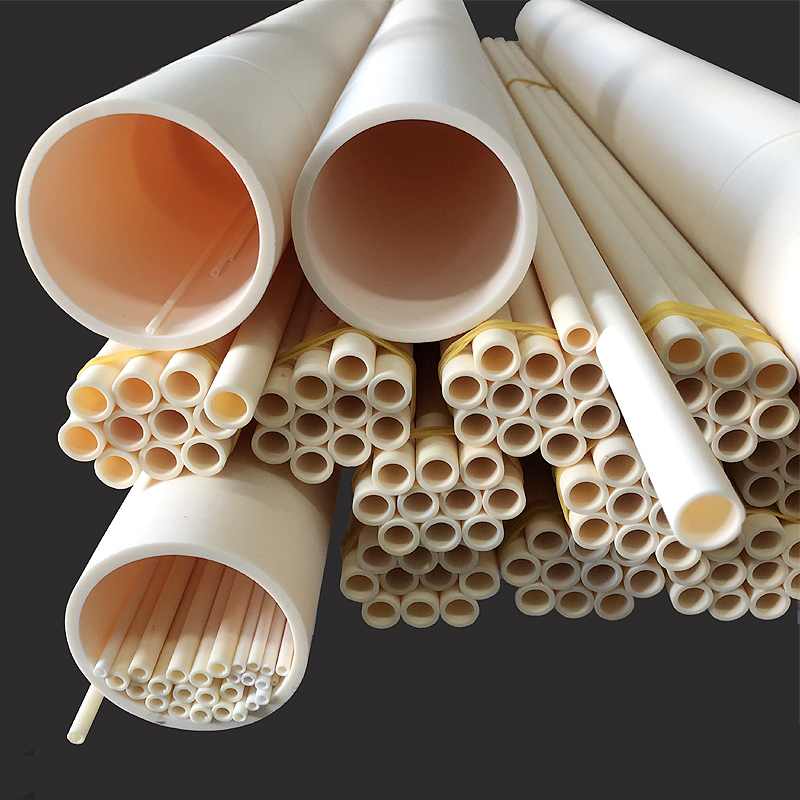
Under high-temperature conditions, creep deformation represents the most critical structural evolution characteristic of alumina ceramic structural components. Unlike their rigid properties at room temperature, ceramic structural parts undergo slow, continuous plastic deformation over time under sustained loading at high temperatures. Moreover, higher temperatures and greater external stresses lead to an accelerated creep rate and more pronounced deformation magnitude.
The mechanical properties exhibit a synchronous gradient attenuation characteristic. As the temperature rises continuously, the internal grain boundaries of alumina ceramics gradually soften, microdefects diffuse within the originally dense and stable crystal structure, and the flexural, compressive and impact resistance properties decline steadily.
Structural components exposed to a high-temperature range of 1200 °C to 1500 °C for a long time are most prone to irreversible structural deformation and strength loss, which constitutes the core cause of failure for lining refractories of industrial high-temperature furnaces and high-temperature load-bearing ceramic components after long-term service.
By contrast, high-purity alumina ceramics contain fewer internal glassy phase impurities and feature superior grain boundary stability. Compared with standard-purity counterparts, they display a markedly slower rate of structural deformation at elevated temperatures, boasting more prominent comprehensive high-temperature resistance performance.
In addition to changes in mechanical structure, the electrical insulation performance of alumina ceramics exhibits regular degradation as temperature rises. Data indicates that the volume resistivity of alumina ceramics at room temperature can reach 10¹⁴–10¹⁵ Ω·cm, delivering outstanding insulating properties. At 800 °C, its resistivity drops to 10⁸–10⁹ Ω·cm, and remains above 10⁶ Ω·cm at 1200 °C. Although the material still retains overall insulating capacity, its electrical conductivity increases slightly. While this characteristic weakens the insulating protection performance under extreme high temperatures, it also provides unique material property support for signal detection and circuit matching of high-temperature sensors and high-temperature electrical equipment.
Industry technical experts state that the high-temperature property variations of alumina ceramic structural components exhibit highly regular and controllable characteristics. By optimizing grain size distribution, improving raw material purity, and incorporating modified dopants such as magnesium oxide and yttrium oxide, the grain boundary structure can be effectively strengthened, significantly enhancing the material’s high-temperature creep resistance and crack resistance while slowing the rate of performance degradation.