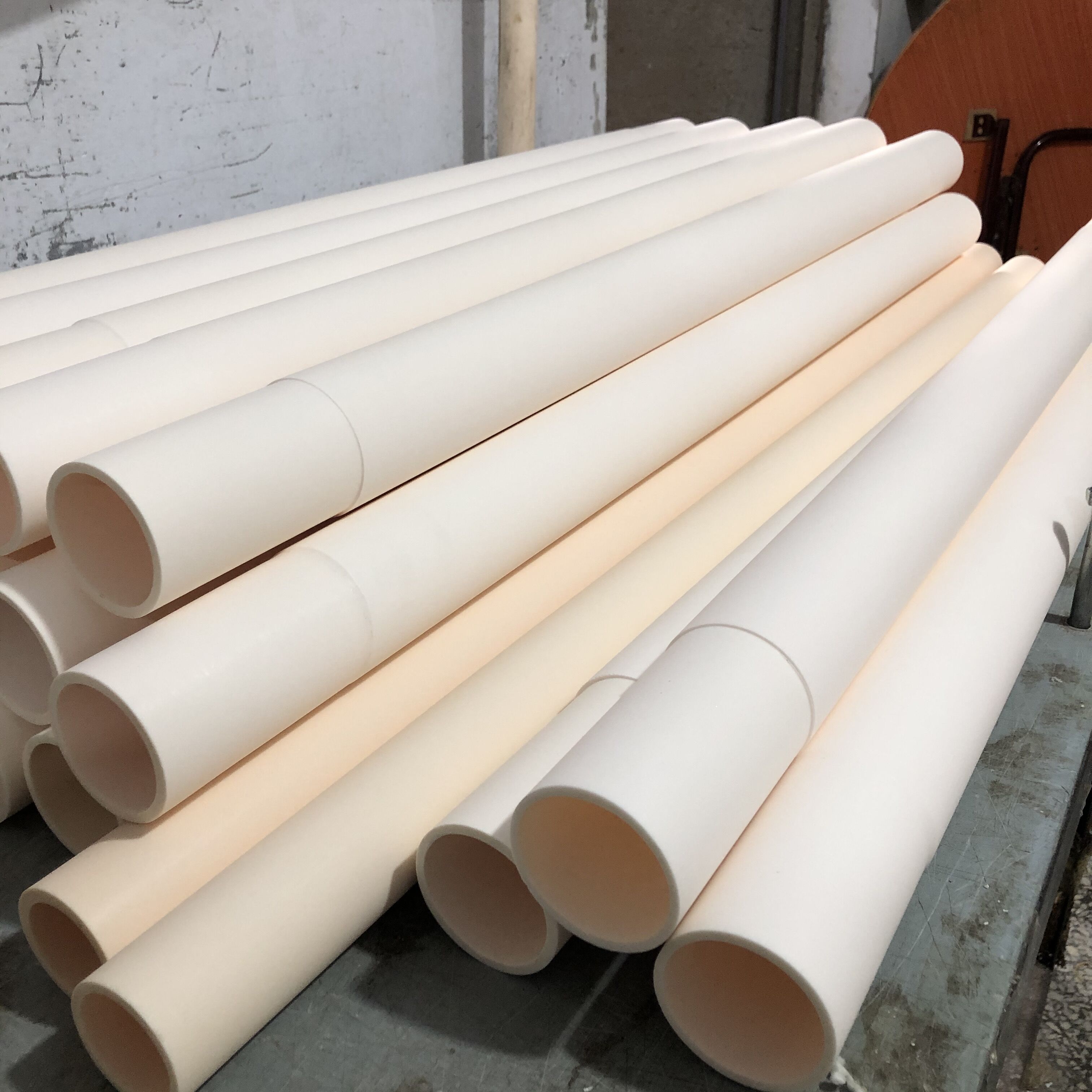
According to testing data from the materials industry, conventional alumina ceramic tubes have limited thermal shock resistance. They are not completely vulnerable to thermal shocks, yet cannot withstand working conditions with drastic alternating hot and cold temperatures.
Manufactured from alumina powder via high-temperature sintering, these tubes have a melting point above 2000°C and can operate stably at 1600°C for a long time, boasting excellent structural stability under high heat — this is why they are a key material for high-temperature industrial applications.
Restricted by its inherent physical properties, the material features a relatively high coefficient of thermal expansion and low thermal conductivity. Sharp temperature fluctuations create a substantial temperature difference between the inner and outer layers of the tube, generating intense internal thermal stress. Once the stress exceeds the material's bearing capacity, cracks, spalling or even bursting will occur.
Industry standard test data defines the thermal shock resistance threshold of standard products. Currently, mainstream 99% purity alumina ceramic tubes on the market can withstand a safe temperature shock difference of approximately 200℃ to 250℃. Under normal operating conditions with uniform heating, constant temperature stabilization and slow cooling, the tubes maintain structural integrity and boast a service life of tens of thousands of hours. However, extreme working conditions — such as cold tubes coming into direct contact with intense open flames, rapid air cooling of hot tubes, and instantaneous alternation of hot and cold temperatures — will easily cause damage from thermal shock. Compared with special materials like silicon carbide and zirconia ceramics, pure alumina ceramic tubes have notable deficiencies in thermal shock resistance. Their high brittleness and poor thermal stability remain the key drawbacks limiting their application.
To address the weakness of poor thermal shock resistance, domestic advanced ceramic material enterprises have teamed up with university research teams for continuous technological breakthroughs in recent years. Multiple modification technologies have been industrialized, greatly improving the environmental adaptability of alumina ceramic tubes.
The upgraded high-performance alumina ceramic tubes feature a markedly improved thermal shock resistance temperature difference threshold, while retaining the core advantages of high temperature resistance, corrosion resistance and superior insulation. Their cost performance is far better than that of fully specialized ceramic materials. Currently, these optimized products have been widely used in high-end scenarios such as high-temperature furnaces in precision laboratories, new energy sintering equipment, high-temperature reaction pipelines for the chemical industry, and temperature-measuring protection tubes for metallurgy. They effectively address the industry pain points of frequent cracking and unplanned downtime for maintenance of traditional pipes, and greatly cut down enterprises' operation and maintenance costs.