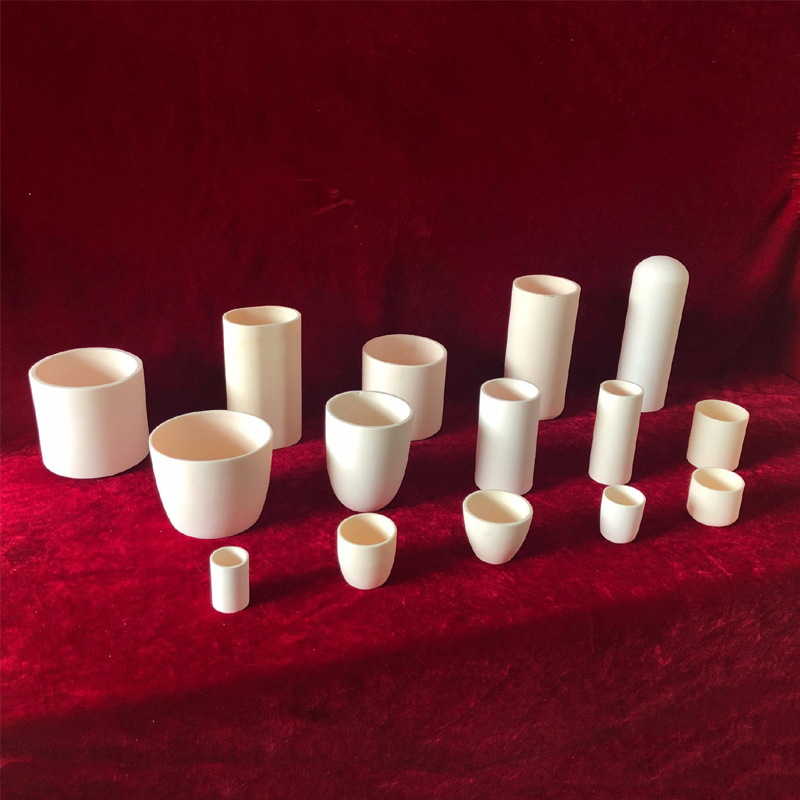
In fields such as material testing, chemical analysis and metallurgical experiments, high-performance alumina crucibles are indispensable core consumables for laboratories and industrial production thanks to their excellent high-temperature resistance and corrosion resistance. Their standard use is also crucial for ensuring experimental accuracy and extending the service life of equipment.
Alumina crucibles, also known as corundum crucibles, are fired using high-purity alumina as the core raw material. High-purity corundum crucibles with an alumina content of over 95% deliver superior performance.
They feature high hardness and excellent fire resistance, alongside outstanding thermal stability and chemical inertness. Under normal working conditions, they can withstand a long-term high temperature of 1650°C, with a short-term maximum temperature resistance up to 1800°C — far better than ordinary porcelain and metal crucibles. These crucibles effectively prevent deformation, cracking and sample contamination at high temperatures.
In addition, they boast remarkable chemical corrosion resistance and can withstand erosion from most common reagents, ensuring the accuracy of experimental data.
Alumina crucibles are widely used in university laboratories, research institutions, industrial and mining enterprises. They are mainly applied in experimental and testing procedures such as sample ignition, solution concentration and crystallization, melting of metallic and non-metallic materials, and high-temperature ashing. They are suitable for sample treatment with weakly alkaline fluxes like anhydrous sodium carbonate, but not for melting experiments using strong alkaline or strongly acidic fluxes, so as to prevent corrosion and damage to the crucibles.
According to industry technicians, standard operation is key to maximizing the performance and service life of alumina crucibles.
In addition, operators shall use clean and dry crucible tongs to handle the utensils. Wear heat-resistant gloves during high-temperature operations and avoid touching the inner walls with bare hands. After the experiment, let the equipment cool down naturally and slowly. Sudden cooling or heating is prohibited. Clean off residual materials and store the utensils properly afterwards. Qualified alumina crucibles can be repeatedly cleaned and reused. Featuring outstanding cost performance and stability, they serve as essential tools for high-temperature precision experiments and industrial testing.