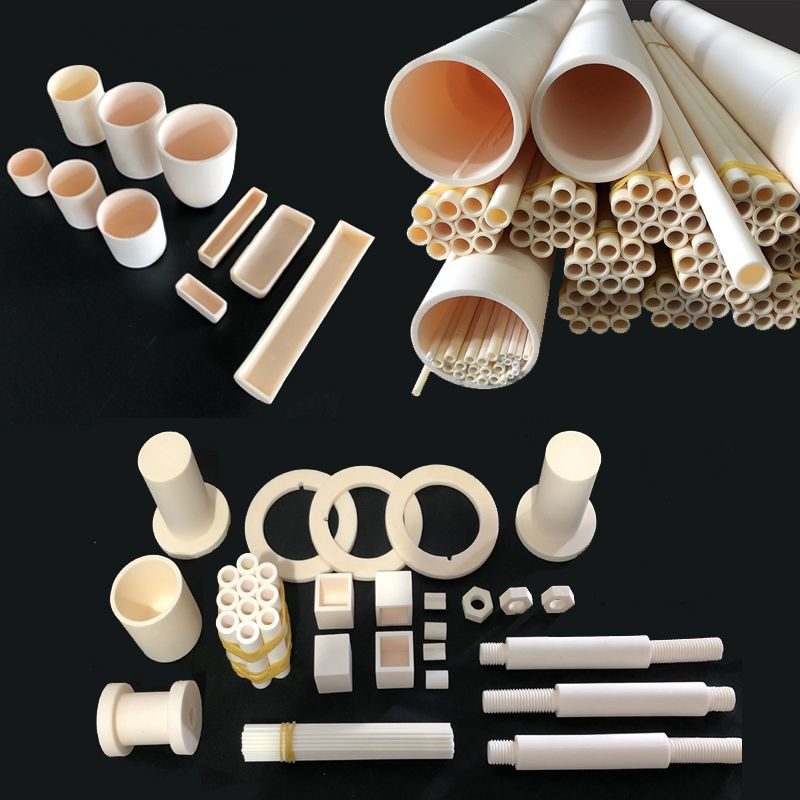
Industrial ceramics are almost ubiquitous in industry due to their properties such as high hardness, high strength, high temperature resistance, and corrosion resistance. Below, taking three common types of industrial ceramics as examples, we will briefly introduce their respective advantages and typical applications.
1. Alumina ceramics (Al₂O₃): The most widely used structural ceramic.
Alumina is a very "mainstream" ceramic material, which is often classified into different grades such as 75%, 85%, 95%, and 99% according to its purity. The higher the purity, the better the material's temperature resistance, mechanical properties, and chemical stability.
The main reasons why it is widely used are as follows:
It has a high melting point (2050℃) and can well resist the erosion of molten metals such as Be, Sr, Ni, Al, Fe, Ta, Mn, etc. It also has high tensile resistance to erosion by NaOH, glass, and slag. It does not react with Si, Sb, or Bi in an inert atmosphere. Therefore, it can be used as refractory materials, furnace tubes, glass drawing crucibles, hollow spheres, fibers, thermocouple protection sleeves, and so on.
2. Zirconia ceramics (ZrO₂): A "special ceramic" with high toughness and corrosion resistance
Zirconia ceramics are white in color, and appear yellow or gray when containing impurities. They generally contain HfO₂ impurities, which have similar chemical properties to ZrO₂ and are not easy to separate.
ZrO₂ is very stable in oxidizing atmospheres and also quite stable in reducing atmospheres. Zirconia is a weakly acidic oxide that can resist erosion by acidic or neutral slags (but is susceptible to erosion by alkaline slags). Therefore, it can be used as special refractory materials and casting nozzles, as well as crucibles for smelting metals such as platinum, palladium, and rhodium. Zirconia is non-wetting with molten iron or steel, so it can be used as the lining of steel ladles and steel flow troughs, and as nozzle bricks in continuous steel casting.
3. Boron Nitride (BN): A High-Temperature Material Known as "White Graphite"
Boron nitride has three polymorphs: hexagonal, close-packed hexagonal, and cubic crystal forms. Hexagonal boron nitride has a graphite-like layered structure and appears as a white powder, with many similar properties to graphite, hence it is also called "white graphite". It can achieve non-stickiness to metals just like graphite, but has higher temperature resistance and better stability than graphite.
Taking advantage of its properties such as high melting point, low thermal expansion coefficient, and stability to almost all molten metals, it can be used as a crucible for high-temperature metal smelting.