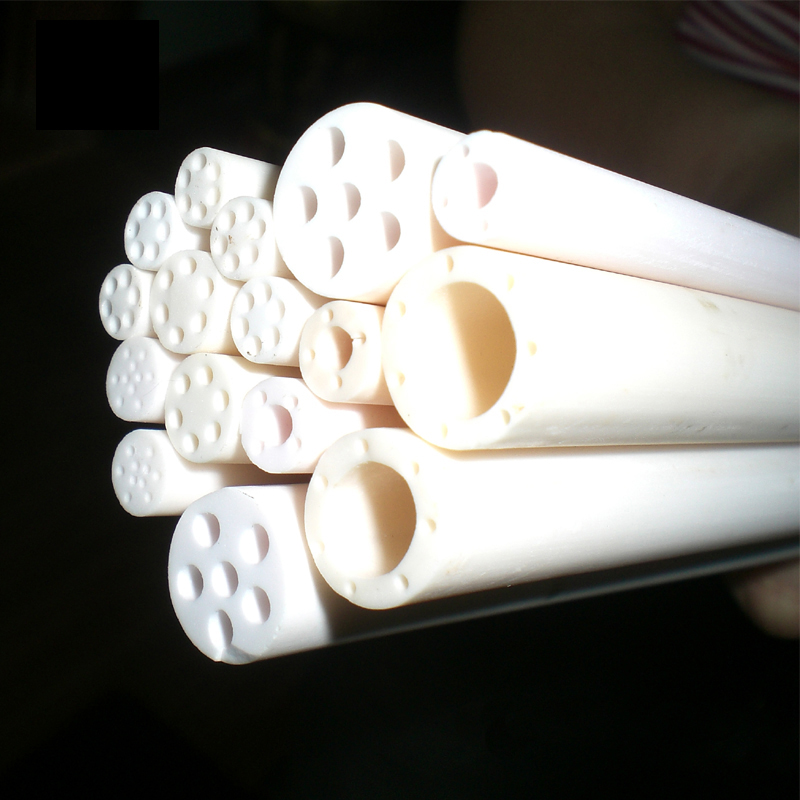
Ⅰ,The core material advantages of alumina ceramic tubes for electrochemical research
1. Ultimate Electrical Insulation: Superior insulating performance from room temperature up to 1600 °C. It isolates platinum, molybdenum and tungsten electrode leads to prevent short circuits in high-temperature electrolytic cells and eliminate clutter interference on EIS and CV test signals.
2. Chemical Inertness: Resists corrosion from strong acids, strong alkalis, molten salts and plasmas. No impurity ion migration occurs with electrolytes or electrode materials, ensuring electrochemical data free from background contamination.
3. High-temperature stability: 99% alumina ceramic tubes maintain dimensional stability without deformation at a long-term service temperature of 1600°C and short-term peak temperature of 1800°C, suitable for molten salt electrolysis, solid oxide fuel cells (SOFCs), and high-temperature impedance testing equipment.
4. Dual configurations (porous / dense) available: Dense tubes serve as electrode insulating sleeves and thermocouple protection tubes; porous alumina ceramic tubes are used as ionic separators, gas diffusion channels, and liquid junctions for reference electrodes.
5. Mechanical rigidity: The integrated multi-through-hole structure fixes the relative positions of three electrodes, eliminates electrode drift, and improves the repeatability of cyclic voltammetry and chronoamperometry tests.
Ⅱ,Complete application cases of electrochemistry in universities
Case 1: University of Science and Technology of Beijing – Diaphragm for Electrochemical Reference Electrodes Under High-Temperature Molten Salt Corrosion (Molten Salt Electrochemistry)
Research Topic
Electrochemical characterization of high-temperature hot corrosion of metals in molten sulfate systems; construction of a three-electrode system operating at molten salt temperatures ranging from 800 to 900°C
Application scheme of alumina ceramic tube
Selecting thin-walled porous 99 alumina ceramic tube as Ag/Ag ₂ SO ₄ high-temperature reference electrode membrane:
1. Silver wire sealed inside the tube with molten sodium sulfate (Na₂SO₄) serving as the internal reference electrolyte, and the porous tube wall acting as an ion-conducting barrier.
2. A dense single-bore alumina sleeve encases the reference electrode lead wire to isolate the platinum conductor from molten salt corrosion.
3. The alumina tube is inserted into a high-temperature corundum electrolytic crucible; argon gas is fed into the molten salt through the lateral alumina tube to regulate oxygen partial pressure.
Experimental results and value
The porous alumina diaphragm only permits the conduction of Na⁺ ions and blocks heavy metal impurities in molten salts, with a reference potential drift of less than 3 mV per 24 hours.
Compared with quartz and glass sleeves, alumina ceramic tubes do not soften at 900 °C and remain inert to sulfate reactions. They support continuous high-temperature Electrochemical Impedance Spectroscopy (EIS) and steady-state polarization tests for 72 hours.
This material facilitated the calibration of an in-situ electrochemical probe for high-temperature molten salt alkalinity as described in the research paper, resolving the high-temperature failure issue of conventional glass reference electrodes.