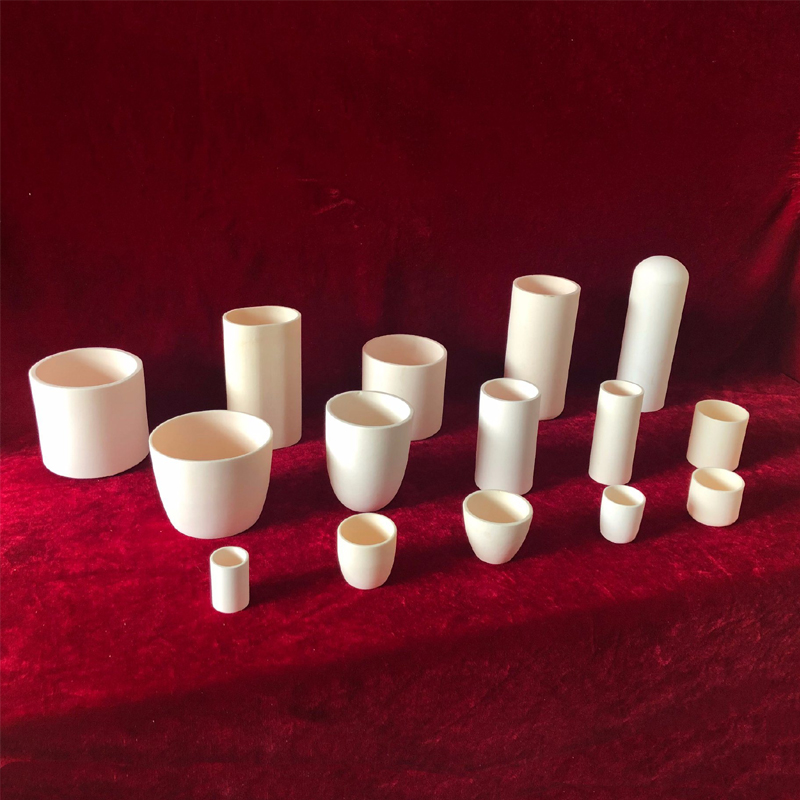
Acid Resistance Performance: Compatible with most acidic media; hydrofluoric acid is the only exception to be avoided.
Hydrofluoric acid (HF) is the primary corrosive medium for alumina ceramic crucibles. A specific chemical reaction occurs between the two substances to form soluble fluoroaluminate complexes, which continuously erode the inner walls of crucibles and lead to cracking and perforation of the crucible bodies. For this reason, alumina ceramic crucibles are strictly prohibited in all experimental and melting processes involving hydrofluoric acid. Apart from this limitation, such crucibles exhibit stable and dependable acid resistance when exposed to common organic acids, dilute strong acids, and concentrated strong acids.
Alkali resistance performance: Limited room temperature tolerance, high temperature concentrated alkali is easily corroded
Its stability will decrease significantly under high-temperature and high-concentration strong alkaline conditions. When the ambient temperature exceeds 60°C and the concentration of strong alkali surpasses 50%, media such as sodium hydroxide and potassium hydroxide will continuously react with alumina materials, slowly corroding the inner wall of the crucible. This results in thinning, cracking and damage of the crucible body.
Meanwhile, industry standards clearly stipulate that alumina ceramic crucibles are strictly prohibited from melting experiments using alkaline fluxes including sodium hydroxide, sodium peroxide and sodium carbonate. High-temperature molten strong alkalis will rapidly destroy the crucible structure, rendering the equipment unusable and even posing potential safety hazards during experiments.
Clear industry application boundaries and standardized use can significantly improve service life
Industry technical specialists remind operators to strictly control service limits in practical applications: avoid hydrofluoric acid in acidic environments; for alkaline conditions, only use under room temperature and dilute alkali scenarios, and prohibit working conditions involving high-temperature concentrated alkali or alkaline fluxes.
Instead of selecting consumables arbitrarily, choosing crucibles compatible with medium properties can not only guarantee precision in experiments and production, but also extend the service life of crucibles by 3 to 5 times, effectively cutting consumable costs and lowering the risk of experimental errors.
With the iterative upgrading of new material technologies, the density and chemical stability of high-purity alumina ceramic crucibles have been continuously optimized, bringing further improvements in corrosion resistance, thermal shock resistance and high-temperature tolerance. Moving forward, thanks to its balanced comprehensive performance, this product will remain a core basic consumable in research, chemical engineering, metallurgy, new material development and other fields. Its refined and scenario-specific selection criteria will also constitute a vital component of standardized industrial development.