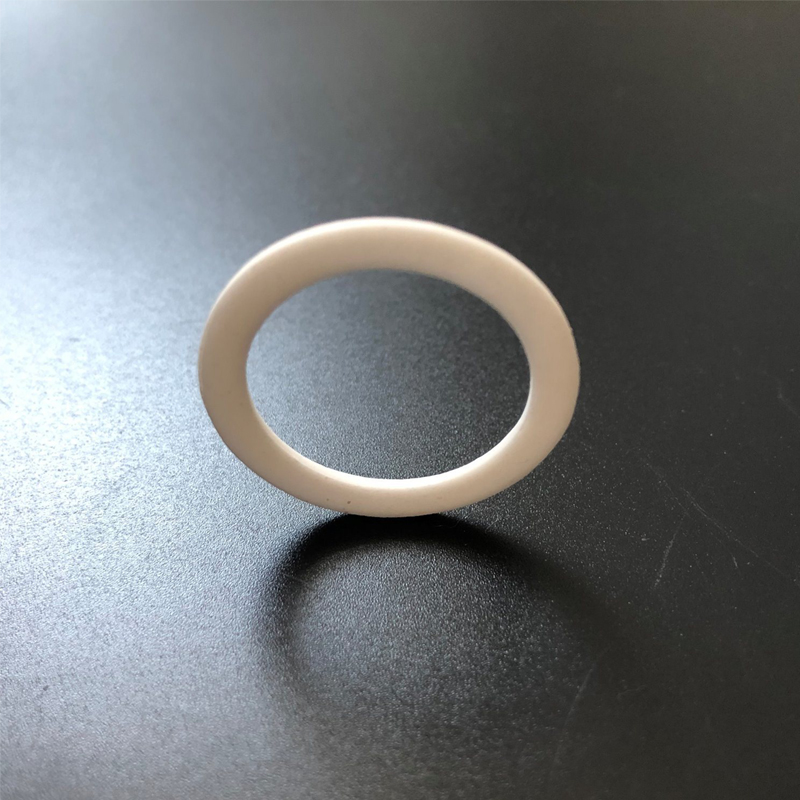
In the vast universe of industrial materials, an ostensibly ordinary ring-shaped object is quietly rewriting the rules of the game. It is not metal, yet harder than metal; not plastic, yet more resistant to high temperatures than plastic; not rubber, yet more corrosion-resistant than rubber. It is the alumina ceramic ring, hailed as the "industrial teeth".
I. Hardcore Performance: Redefining the Standards of Industrial Materials
The core component of alumina ceramic rings is aluminum oxide (Al₂O₃), which forms a dense structure through high-temperature sintering technology, endowing them with three disruptive characteristics.
Hardness Comparable to Diamond: It has a Mohs hardness of 9 (second only to diamond), and its wear resistance is more than 200 times that of stainless steel. In the sand mill of a chemical enterprise, the service life of alumina ceramic rings can reach 3 years, while traditional metal rings can only last for 3 months.
High-Temperature Resistant "Volcano-like" Property: It can withstand high temperatures of up to 1600℃ and remains stable in extreme environments such as glass melting furnaces and metal smelting processes. In a new energy battery production line, alumina ceramic rings are used as electrode supports, and after 1000 hours of continuous operation at 200℃, there is no significant attenuation in performance.
Insulation and Corrosion Resistance "Golden Bell Shield": It has a high resistivity of up to 10¹⁴Ω·cm at room temperature and is resistant to strong acids and alkalis. An electronics factory applied it to the insulating components of high-frequency transformers, and the product failure rate dropped sharply from 5% to 0.3%.
II. Cross-Border Applications: The "All-Round Player" from Aerospace to Medical Care
With outstanding performance, alumina ceramic rings are becoming a key disruptor in multiple fields.
Unsung Hero of the New Energy Revolution: In solid-state batteries, it can increase ionic conductivity by 18% as a diaphragm material and raise the battery thermal runaway temperature by 50℃. After a certain automobile enterprise adopted alumina ceramic insulating parts, the energy density of the battery module increased by 12% and the charging speed accelerated by 20%.
Precision Guardian of the Semiconductor Industry: In the chip packaging process, its coefficient of thermal expansion is highly matched with that of silicon wafers (7.6×10⁻⁶/℃), which can avoid circuit breakage caused by temperature changes. After a semiconductor factory introduced it, the packaging yield rate increased from 88% to 97%.
"Bone Ceramic Legend" in the Medical Field: Its biocompatibility makes it an ideal material for artificial joints, with a friction coefficient of only 0.02 (equivalent to that of human articular cartilage). Clinical data from a hospital shows that patients with alumina ceramic joints have a 92% activity retention rate 5 years after surgery.
III、 Technological breakthrough: achieving a win-win situation of cost-effectiveness and performance
For a long time, high production costs have limited the popularization of alumina ceramic rings. However, three major technological innovations in recent years are breaking this predicament:
Low-Temperature Sintering Technology: By adding nano-scale sintering aids, the sintering temperature is reduced from 1700℃ to 1400℃, cutting energy consumption by 30% and lowering production costs by 25%.
3D Printing Revolution: Qiyu Technology has successfully printed alumina ceramic Möbius rings with complex structures using DLP light-curing technology, increasing material utilization rate from 60% to 95%.
Composite Structure Design: A spark plug enterprise combined high-performance alumina with ordinary alumina, reducing costs by 58.3% while ensuring insulation performance.