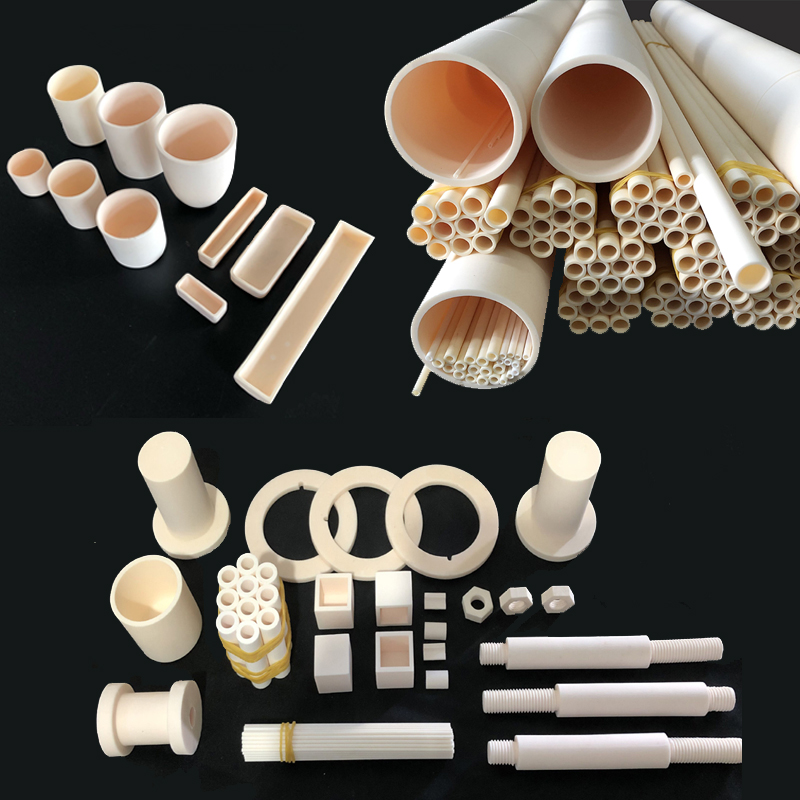
In recent years, with the adjustment of national policies, the semiconductor industry has developed rapidly and its industrial scale has expanded drastically. Meanwhile, semiconductor manufacturing equipment has been continuously evolving toward higher precision and greater complexity.
Owing to their advantages including high hardness, high elastic modulus, excellent wear resistance, high insulation, strong corrosion resistance and low thermal expansion, ceramics can be used as components for semiconductor equipment such as silicon wafer polishers, heat treatment equipment (e.g., epitaxy, oxidation and diffusion systems), lithography machines, deposition equipment, semiconductor etching equipment and ion implanters. Therefore, the R&D and production of precision ceramic components directly impact the development of the semiconductor industry, and the requirements for their preparation technologies have become increasingly stringent.
Due to their position and importance in semiconductor equipment, industrial ceramic components must meet strict requirements for industrialization in the semiconductor field in the following three aspects:
Industrial ceramic material performance: It must meet the comprehensive performance requirements of semiconductor equipment for materials in mechanical mechanics, heat, dielectric, acid and alkali resistance, and plasma corrosion.
Precision machining of hard, brittle, and difficult to process materials: Industrial ceramic materials belong to hard, brittle, and difficult to process materials. Semiconductor equipment requires high precision for components, and machining has always been one of the bottlenecks in the application of ceramic components in semiconductor equipment.
Surface treatment of processed new products: Due to the fact that ceramic components in semiconductor equipment usually tightly surround the wafer, and some even directly contact the wafer, the control of surface metal ions and particles is extremely strict. Surface treatment after processing is one of the key technologies for the application of ceramic components in semiconductor equipment.
Semiconductor ceramics include aluminum oxide, silicon nitride, aluminum nitride, silicon carbide, etc. In semiconductor equipment, the value of precision ceramics accounts for about 16%. There are various types of industrial ceramic materials used in semiconductors, each with unique properties and applicable fields. The following are common industrial ceramic materials, their characteristics, and application areas:
Features:
High hardness and high wear resistance.
Good insulation performance.
High temperature resistance (melting point approximately 2050 ℃).
Good chemical stability and corrosion resistance.
Application fields:
Wafer Boat
Insulated components.
Chemical Mechanical Planarization (CMP) Pad
Encapsulation Substrate
2. Aluminum Nitride (AlN)
Features:
High thermal conductivity (approx. 170–200 W/m·K).
Low coefficient of thermal expansion (close to that of silicon).
Excellent electrical insulation.
High temperature resistance and thermal shock resistance.
Application fields:
Semiconductor Package Substrate
Heat Sink and Heat Dissipator
High-power Electronic Devices
Heater for Thin-film Deposition Equipment
3. Silicon carbide (SiC)
Features:
Extremely high hardness (Mohs hardness 9.2).
Excellent high-temperature resistance (melting point approx. 2700°C).
High thermal conductivity (approx. 120–200 W/m·K).
Corrosion resistance and wear resistance.
Application fields:
Components of Etching Equipment
High-temperature Heater
Semiconductor Wafer Boat
Substrate for High-power Electronic Devices
4. Silicon Nitride (Si₃N₄)
Features:
High strength and high toughness.
High temperature resistance (melting point approx. 1900℃).
Excellent thermal shock resistance.
Corrosion resistance and wear resistance.
Application fields:
High-temperature structural components
Carriers in semiconductor manufacturing equipment
Thermal management materials
High-reliability packaging materials
These industrial ceramic materials play a key role in semiconductor manufacturing, meeting the requirements for high precision, high reliability and high performance, and driving the advancement of semiconductor technology.